
Uncategorized
Eid Mubarak to all MM Readers! Bonus: Eid North Nigeria Style!

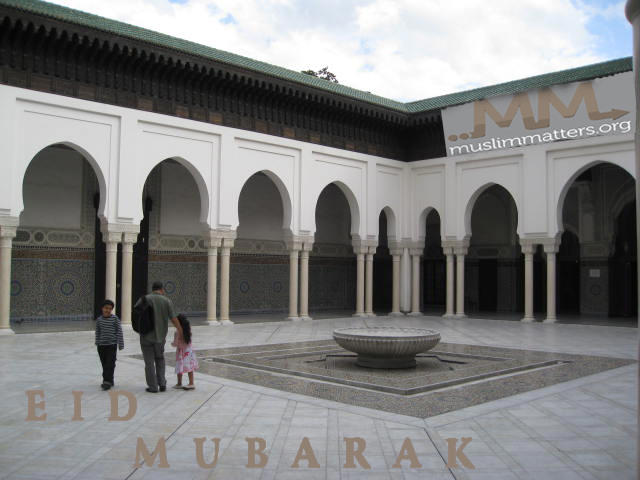
Grand Mosqee de France, Paris (Copyright: MuslimMatters.org)
Keep supporting MuslimMatters for the sake of Allah
Alhamdulillah, we're at over 850 supporters. Help us get to 900 supporters this month. All it takes is a small gift from a reader like you to keep us going, for just $2 / month.
The Prophet (SAW) has taught us the best of deeds are those that done consistently, even if they are small. Click here to support MuslimMatters with a monthly donation of $2 per month. Set it and collect blessings from Allah (swt) for the khayr you're supporting without thinking about it.
The following is an appropriately timed guest submission by sister Aisha Mijndadi Ajikobi
Eid in Nigeria is popularly known as “Sallah” to the Northerners and “Ileya” to the Southerners. These days, most people take holidays and go home back to their roots, to their villages. Families get together this one time every year and celebrate. The big cities are empty during these periods. Picnics, parks…and loads of fun.
Eid, however, struck me most as a child. Those are moments to treasure and moments I want my kids to be brought up with.
Waking up, is like a great day beginning. The excitement is overwhelming! Our clothes have been hung up from the night before. The famous Hausa (a tribe in Northern Nigeria) “Shada” material is sewn into kaftans for the boys, and wrapper styles for the girls.
Driving to the nearest Eid ground, we begin the takbir. As a kid, I never understood its significance or importance, but it was still fun! To scream “Allahu akbar”, while the others chorused after us. Each taking turns, one person began the refrain:
“Subhanallah,
Alhamdulillah,
Wa la illaha illAllah,
Allahu Akbar!”
Once we began to tire, our father’s voice would urge us from the driver’s seat, and we’d start again.
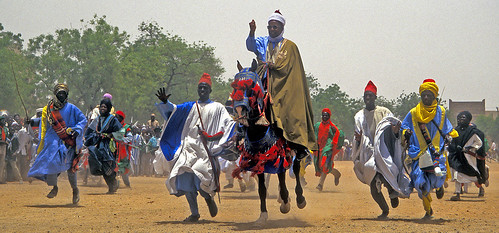
Katsina Charge at the annual Durbar festival. Photo by Jay.
In the northern part of Nigeria, where I grew up, children dress to the nines, and throng the streets walking to the Eid ground, some riding on the back of open air trucks shouting the takbir. Once the salat begins, the complete silence is blissful, as the opening takbir is called and the prayer said. Once the Imam gives the salams, the children take off through the grounds buying iced drinks, dried dates and giving alms, while most parents listen to the khutbah above the din. Seven canon shots are fired in the air, signalling the end of the khutbah, and the Emir (the leader of the Muslims) leaves the grounds.
From 4pm after the Asr prayer, the “durbar” is held at the Emir’s palace – a parade of dazzling adorned horses and their riders. Apparently, it is a spectacle to behold, but unfortunately, I’ve only ever heard about it. For us, we head back home – there, the slaughtering begins.
Muslims in the North tend to buy their rams months ahead so as to beat the rise in price that occurs as Eid day approaches. For this reason, kids develop an attachment to the animals. I remember a particular Eid I almost didn’t eat the ram meat because he was “my friend”!
Friends start visiting the home front to give well wishes; but we, the kids of the family, set out with parcelled meat to our Muslim family and friends’ houses around town. This takes the most part of the afternoon as we skip from home to home, collecting money gifts from parents, and in some cases, exchange meat parts from other homes.
By evening time, we set out again to distribute food parcels to all our neighbours so they may share the beauty of the Eid with us…and also add to our burgeoning piggy banks! The day ends on a high while we count our earnings.
Eid in Nigeria is for two days. The following morning, we set out by 10am, this time visiting almost all of our Muslim friends around town, having made a list from the day before. We always know the homes that would serve the snacks and delicacies that we loved!
The third day will be work or school – the easy smiles, pretty dresses and ram meat will disappear but for those days…..
This is our Eid!
—
Aisha Mijndadi Ajikobi has a first degree in Accounting and an MA in Mass communication. When she’s not spending precious moments struggling with her eeman, being with her loving husband and two beautiful boys, she’s trying to rekindle her earliest love… writing.
Keep supporting MuslimMatters for the sake of Allah
Alhamdulillah, we're at over 850 supporters. Help us get to 900 supporters this month. All it takes is a small gift from a reader like you to keep us going, for just $2 / month.
The Prophet (SAW) has taught us the best of deeds are those that done consistently, even if they are small. Click here to support MuslimMatters with a monthly donation of $2 per month. Set it and collect blessings from Allah (swt) for the khayr you're supporting without thinking about it.





Israel Seeks Escalation For Latitude – The Regional “Conflict” Widens

Post-Ramadan Reflections From A Mother Of Littles

[Podcast] Palestine in Our Hearts: Eid al-Fitr 1445 AH

Foreign Affairs Official Resigns Over Gaza Genocide

A Ramadan Quran Journal: A MuslimMatters Series – [Juz 30] Solace For The Sincere And Vulnerable

IOK Ramadan: 7 Qualities of Highly Effective Believers | Keys To The Divine Compass [Ep18]
IOK Ramadan: Choose Wisely | Keys To The Divine Compass [Ep15]
IOK Ramadan: Making Time for Allāh at Night | Keys To The Divine Compass [Ep21]
IOK Ramadan: Appreciating the Prophet ﷺ | Keys To The Divine Compass [Ep22]
IOK Ramadan: They Were Not Created Without Purpose | Keys To The Divine Compass [Ep23]

IOK Ramadan: The Importance of Spiritual Purification | Keys To The Divine Compass [Ep30]
IOK Ramadan: The Power of Prayer | Keys To The Divine Compass [Ep29]
IOK Ramadan: The Weight of the Qur’an | Keys To The Divine Compass [Ep28]
IOK Ramadan: Families of Faith | Keys To The Divine Compass [Ep27]
IOK Ramadan: Humility in Front of the Messenger | Keys To The Divine Compass [Ep26]
-

 #Islam3 weeks ago
IOK Ramadan: 7 Qualities of Highly Effective Believers | Keys To The Divine Compass [Ep18]
-
#Islam3 weeks ago
IOK Ramadan: Choose Wisely | Keys To The Divine Compass [Ep15]
-
#Islam2 weeks ago
IOK Ramadan: They Were Not Created Without Purpose | Keys To The Divine Compass [Ep23]
-
#Islam3 weeks ago
IOK Ramadan: Making Time for Allāh at Night | Keys To The Divine Compass [Ep21]
Yus from the Nati
December 8, 2008 at 12:39 AM
WOW that’s BEAUTIFUL mA!
Amad
December 8, 2008 at 12:41 AM
Eid Mubarak to everyone! Looking forward to fresh meat tomorrow :)
Eid in the West is nothing compared to the fun of celebrating it in the Muslim lands! Esp. the freshly bbq’d kalaiji (for those who understand :) ).
But inshallah we are working towards it (making it funner) :) Unfortunately, no 6 flags ICNA stuff on this Eid. Makes you thank ICNA again for the fun for eid-al-fitr @ 6 flags.
Algebra
December 8, 2008 at 12:54 AM
Aslamlu-alaikum:
Yea I sooooooooooo agree with you. When i was in Lahore last bakarah EID it was sooooooooooo fun. I loved mashAllah
I miss pakistan during these times.
salam
Amatullah
December 8, 2008 at 1:23 AM
Taqabal Allahu minaa wa minkum, Ameen. Eid Mubaarak!
I’ve never celebrated an eid in a country other than Canada or the US…InshaAllah next year we will be in Makkah.
sis
December 8, 2008 at 1:31 AM
Eid Mubarak !
Jazakallaahu khayr for sharing about Nigeria with us sr. Aisha!
tawheedfirst
December 8, 2008 at 1:42 AM
TaqabalAllahu minna wa minkum!
Mohammed Faisal
December 8, 2008 at 1:52 AM
Eid Mubarak!
Algebra
December 8, 2008 at 2:11 AM
Aslamu-alaikum:
I would like to know why my comments have offended anyone on your blog………..
Just because you don’t agree with views doens’t mean that you should stop me from voicing them.
salam
Eid MUBARAK
Your comments are edited because they are not germane to the post. If you wish to discuss the merits or demerits of polygyny, then please do so on one of the posts about that subject. While discussing polygamy may be the ideal way of wishing each other eid greetings for some people, it is not our idea of eid greetings here at MM. we look forward to your comments in the future, but please keep them on topic. jazaki-Allahu khayr -Editor.
abu abdAllah, the Houstonian
December 8, 2008 at 3:45 AM
Eid Mubarak!!!
Allahumma taqabbul minkum wa minna! If you’re in Houston, see you at Reliant, inshaAllah!!!
(Want to keep the Eid-feeling going the whole month: come down for TDC.)
iMuslim
December 8, 2008 at 6:38 AM
Eid Mubarak. TaqabAllahu minna wa minkum.
Ali Colak
December 8, 2008 at 9:52 AM
Eid mubarak.
abu abdAllah, the Houstonian
December 8, 2008 at 10:11 AM
bismillah. make a lot of dua that this news story is the precursor to a great Eid present: the revelation of exculpatory evidence in the case of Shaykh Dr. Ali Al-Timimi, inshaAllah.
Eid Mubarak!!
OsmanK
December 8, 2008 at 11:07 AM
eid mubarak!
Farhat Manzoor
December 8, 2008 at 5:58 PM
assalamuallikum
taqabalAllahu minna waminkum .
LearningArabic
December 8, 2008 at 6:25 PM
Eid Mubarak to All!
The Eid in Nigeria seems like a lot of fun. Anyone down to make a trip out to Africa next year!
bintwadee3
December 8, 2008 at 10:04 PM
“I remember a particular Eid I almost didn’t eat the ram meat because he was “my friend”! ”
SubhanAllaah! Big time deja vu. Same thing happened to me when I was 6. I was bawling when my dad slaughtered our lamb. As if that wasn’t bad enough, he made me taste it. But if I didn’t like it, I didn’t have to eat it. It tasted good, but I was not going to eat “my friend”.
Abu Abdullah (and company), make du’a Congress’s new law does not apply to this case. A bit of “light” reading for you:
Eid Mubarak everyone. Kul 3am w entom bikheir.
ibnabeeomar
December 9, 2008 at 12:00 PM
eid mubarak from aerosol arabic
http://uk.youtube.com/watch?v=0PLYAkg-nP0
ibnabeeomar
December 9, 2008 at 12:26 PM
eid ul adha from around the world:
http://www.guardian.co.uk/world/gallery/2008/dec/08/islam-religion1?picture=340486178
Algebra
December 9, 2008 at 12:57 PM
Aslamu-alaikum:
I liked your pictures on the guardian. I dont’ know about the bloody ones though……….. I have to write slowly since i am proctoring an exam.
The perks of teaching one can still blog on down time at a college………..
I am sooooooooo happy Allah didn’t make us slaughter the animals i would find it really hard………. it would be so difficult for me to do that.
I don’t know how you guys do it. I ask my brothers the same thing and there ok with it………….I can’t even wash meat……….. i make my brothers do it.
i just will not wash it.
i know i know i can be a ……………………..
salam
mudsir
December 16, 2008 at 4:11 PM
http://www.boston.com/bigpicture/2008/12/the_hajj_and_eid_aladha.html