
Family and Community
Raising Children in the West- How Do You Define Respect (Part 2)

This is the second of a three-part series on parenting in the West.
Raising Children in the West- How Do You Define Respect by Umm Reem © MuslimMatters.org
Part 1 | Part 2 | Part 3
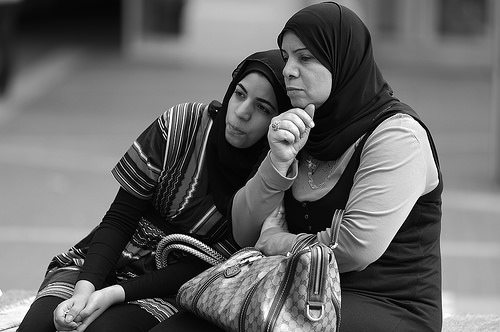 Friendship & Respect:
Keep supporting MuslimMatters for the sake of Allah
Alhamdulillah, we're at over 850 supporters. Help us get to 900 supporters this month. All it takes is a small gift from a reader like you to keep us going, for just $2 / month.
The Prophet (SAW) has taught us the best of deeds are those that done consistently, even if they are small. Click here to support MuslimMatters with a monthly donation of $2 per month. Set it and collect blessings from Allah (swt) for the khayr you're supporting without thinking about it.
I strongly believe that there is a need for one of the parents to be the children’s friend, especially while living in the West. What I mean by friendship is to have a kind of relationship with the children where parents themselves take “initiatives” in explaining issues to them that are normally avoided, and give them a level of confidence that they can practically and literally approach their parent with any and every question they may have. Normally it is the mother who ends up being the friend. If so, then who disciplines the child?
I believe both mother and father discipline the child but in different ways; mother takes the friendly approach and father takes the “formal” approach. This is not an easy topic to tackle and I may have to write a whole separate entry on it. But to make it really short, when a parent takes a “friendly” approach towards his/her child, then by default, children will cross over some boundary of respect. It takes far more patience on the parent’s part. I am still experimenting with this issue, and this will go through the litmus test when my children hit their teenage years, inshaAllah. Let’s hope for the best!
However, one point that I must mention is that the parent must develop an understanding with the children to be “cautious” in their dealings with the parents when others/outsiders are around. Not only is the parent’s level of sensitivity higher when others are around, but also, others have a tendency to judge and pass remarks which may be hurtful for the parent and for the children.
Hear & Obey:
A. Talking Back or Asking Questions:
“But why” “How come,” “That’s not fair,” “Why do I have to?”
Sound familiar?!
Yet many parents complain, “But we never acted like this with our parents!”
As much as I wish children just “listen and obey,” I also realize the importance of asking questions and discussing an issue that might be difficult to understand.
I want to steer my children’s thoughts towards the positive, and want them to understand what and why they are being told to do something, or are denied a request, or are getting punished for whatever it may be. This is to avoid letting shaytaan play with their thoughts. For example, they might:
a. blame the parents for being “unfair”
b. think Islam is a difficult religion
c. be ungrateful and under-appreciate the blessings they have, thinking everyone else seems to have it easy while they are miserable
I am always concerned about their potential to become rebellious, developing an aversion towards the religion because of its restrictions, and thus losing their trust somewhere along the way. This is not something our parents were/had to worry about when they were raising us. Those parents who raised their children overseas had an advantage, and as for the immigrant parents, either most of them were not as religiously strict or are now facing problems. (wAllahu ‘alam)
To keep a track of what is going through their minds, I don’t mind my children asking questions, defending their point of view, voicing their opinion; but I realize that it must be conditional, and these conditions should always be reminded and consistently implemented:
- Tone of the voice must not be harsh
- Volume must remain under control
- Words must be polite and respectful
(1) and (2) are easier to implement. It is (3) where my children and I struggle the most, and I find myself constantly correcting and reminding them because, at times, the terms they choose are controversial. Like, my son once said to me, “are you crazy” My daughter’s jaw dropped, then she looked at her brother and before I could say something, she said, “you can’t say that to mama!” So somewhere along the way my daughter, alhamdullilah, understood this but my son still needs reminders.
If the above three conditions are met, I don’t mind children questioning or trying to “reason.” For example, when my daughter breaks a rule, I sometimes tend to bombard her with multiple punishments. She asks me why she got multiple punishments for one wrong. If I agree with her (depending on the intensity of the act) I carry out one punishment and cancel out the others; if not, then I explain to her my reasoning and still implement the punishments.
Similarly, sometimes she confesses to me something she may have done behind my back, and at that point she tries to reason with me that since she told the truth herself, I should go easy on her, or better yet not punish her at all! To me, this is not “disrespect,” rather, its an ability to speak, defend, reasonably reason etc. However, and the most important point is that they must recognize the authority of the parent over them!
B. Confidence or Respectful Silence:
I like confident people; I don’t like oppressed personalities. But I appreciate humbleness. It must be noted that there is a very thin line between confidence and disrespect. So, in order to flower a confident personality, a parent will have to be very cautious.
Growing up with the Western mindset of being bold and confident, in addition to having a father who appreciated “outspokenness” didn’t help me much with regards to respecting elders or being humble. I learned much later in my life that there is a place for confidence, a place for opinions, a place for humbleness and a place for staying quite even if right! Can this be taught to children? I think it can with much wisdom, patience and flexibility.
Communication is the key. We, as parents, should spend a lot of time explaining to our children what we expect of them in terms of: Who they can reason with, how much, when etc. I have told my daughter that if I am angry and scolding her, but I tell her to stay quiet (which is not the case all the time) then she should do just so. But once I am not angry anymore then she is permitted to discuss the issue with me. We are still working on that and as she grows older I think, alhamdullialh, it is getting better.
Some situations are harder to explain but some are easier. Like, I’ve told her that when her father comes home from work and he asks her to do something, then she should just listen and not ask questions; once he rests and eats his dinner then she can ask, complain etc. (Sometimes she uses it to her advantage and tells on her brother as soon as baba comes home to get him in “extra”’ trouble!!)
Two points must also be taught:
- Stating one’s opinion is not necessary all the time and in front of everyone.
- In the end, obedience to parents must take precedence
C. Respecting the Authority:
As much as I encourage parents to allow room for discussions and explanations to their children, I must also say that recognition of “authority” must also be established. Not every issue can be reasoned with and/or explained in little, minute details, esp. if children are young. For instance, sometimes I ask my son, “what’s up buddy boy.” So once he asked me “what’s up woman!” I explained to him that “woman” is not a respectful term to use for his mother, and he rebutted, “but you are a woman!” Obviously “we” would not have responded to our parents in such a manner, and the fact that our parents had asked us not to do/say something would have been sufficient for us.
In any case, I continued to offer an explanation how “woman,” when used to address someone, has a negative connotation to it. Then he very thoughtfully asked me, “so when you are outside and you look at the bathroom door, do you feel “disrespect?” “Why,” I asked. He said, “because it says woman on it!”
I think I had offered him enough explanation. He was having difficulty understanding it because of his young age and not knowing the proper usage of the term. So I had to tell him politely but firmly, “I am your mama and I am telling you not to use this term to address any elder lady especially your mother because it is disrespectful.”
I specifically talk about this issue as a separate section because of a number of reasons. When we allow our children room to reason or respectfully question, they can easily loose track of our authority over them. They must realize that they can have discussions with their parents, but in the end of the day, it is the parents who carry out the rulings and not the children.
“Why do I have to listen to you?” I am sure all of us have heard this question. I wish I had a quick answer for this, but it will lead me to a whole discussion of instilling Islamic values from day one (actually even before that) in our children’s lives. And before we call for their obedience, they must be told of the necessity of obeying Allah, azzawajal. So the answer will not be, “because I am your parent,” rather, “because Allah said so!”
As much as it is important to allow them room for discussion, it is equally important that, at times, the answer to their, ‘whys’ or ‘how comes’ should be, “because I, as your mother, said so!”
I must admit that I was not in favor of the “I-said-so” answer, until I was exposed to the whole, “reason over revelation” mentality. I began to realize that I had to teach my children to get used to “submitting to authority” even if it escaped their rationality. In the future, when they pursue their education, they will be exposed to the idea of “rationalism.” Thus, in order for me to instill the habit of “submission” I must, intentionally, make them obey without their having to understand the reason or logic of every single issue. For instance, my husband makes my son put his shoe (i.e my husband’s) on the shoe rack every time they go to the Masjid, although, my son has absolutely no idea why he is told to do so. Or, once in a while, I make my daughter clean up the play room, which she doesn’t even use anymore, and in reply to her whining, my reply is, “because I said so!”
However, this should be carefully balanced out, especially in matters of religion. For a young child, perhaps, it is better to explain the religious rulings as much as possible because of the environment around them, wAllahu ‘alam.
To Be Continued:
- [Part 3] V. Conclusion
- VI. Islam & Respect for Parents
- VII. Juhd, Du’a & Patience
Keep supporting MuslimMatters for the sake of Allah
Alhamdulillah, we're at over 850 supporters. Help us get to 900 supporters this month. All it takes is a small gift from a reader like you to keep us going, for just $2 / month.
The Prophet (SAW) has taught us the best of deeds are those that done consistently, even if they are small. Click here to support MuslimMatters with a monthly donation of $2 per month. Set it and collect blessings from Allah (swt) for the khayr you're supporting without thinking about it.






Israel Seeks Escalation For Latitude – The Regional “Conflict” Widens

Post-Ramadan Reflections From A Mother Of Littles

[Podcast] Palestine in Our Hearts: Eid al-Fitr 1445 AH

Foreign Affairs Official Resigns Over Gaza Genocide

A Ramadan Quran Journal: A MuslimMatters Series – [Juz 30] Solace For The Sincere And Vulnerable

IOK Ramadan: 7 Qualities of Highly Effective Believers | Keys To The Divine Compass [Ep18]
IOK Ramadan: Choose Wisely | Keys To The Divine Compass [Ep15]
IOK Ramadan: They Were Not Created Without Purpose | Keys To The Divine Compass [Ep23]
IOK Ramadan: Making Time for Allāh at Night | Keys To The Divine Compass [Ep21]
IOK Ramadan: Appreciating the Prophet ﷺ | Keys To The Divine Compass [Ep22]

IOK Ramadan: The Importance of Spiritual Purification | Keys To The Divine Compass [Ep30]
IOK Ramadan: The Power of Prayer | Keys To The Divine Compass [Ep29]
IOK Ramadan: The Weight of the Qur’an | Keys To The Divine Compass [Ep28]
IOK Ramadan: Families of Faith | Keys To The Divine Compass [Ep27]
IOK Ramadan: Humility in Front of the Messenger | Keys To The Divine Compass [Ep26]
MuslimMatters NewsLetter in Your Inbox

Sign up below to get started
-

 #Islam3 weeks ago
IOK Ramadan: 7 Qualities of Highly Effective Believers | Keys To The Divine Compass [Ep18]
-
#Islam3 weeks ago
IOK Ramadan: Choose Wisely | Keys To The Divine Compass [Ep15]
-
#Islam3 weeks ago
IOK Ramadan: Making Time for Allāh at Night | Keys To The Divine Compass [Ep21]
-
#Islam3 weeks ago
IOK Ramadan: Appreciating the Prophet ﷺ | Keys To The Divine Compass [Ep22]

Pingback: Raising Children in the West- How Do You Define Respect (Part 1) | MuslimMatters.org
iMuslim
November 13, 2008 at 4:51 PM
Another great article sister, masha’Allah. This bit especially made me chuckle:
Siblings, eh?
Question: you make a lot of comparisons about being a parent in the West vs “back home”, but don’t go into detail about why exactly it was different for our parents’ generation? I mean, is it because of TV, internet, films, etc… i.e., children are influenced by a wider range of factors other than the condition of their immediate family, friends and close community? Why was it easier for the older generation to be more ‘formal’? Is it because liberal attitudes did not exist back then, and they were simply doing things as their parents did them, and their parents before?
Just that I imagine it has always been hard to raise good kids, whatever time and place. Subhanallah, look at the example of Nuh ‘alayhis salam! I am just trying to gauge which traditions are universally beneficial, irrespective of time, place and culture – i.e., core traditions which should not be messed with – versus practices which can be adapted to the subtleties of the existing environment.
From your essay, it seems that you believe ‘strict’ formality is not a core tradition; maybe it worked for previous generations, but it won’t work now, and we have to adapt. Allahu ‘alam. Perhaps we will find our children raising their own kids in very different ways; even going back to the way our grandparents did things! May Allah guide them and us to what is pleasing, ameen.
I do find parenting works in cycles. For example, my grandfather was very strict with my father, most likely due to economic hardship, as well as personality. This is part of the reason why my dad tends to spoil me; I guess out of a sense of empathy, and because he can afford to do so. What does that mean for my kids? Allahu ‘alam.
We have all had the thought: “I am SO not doing that to MY children!”, whereas in fact, it is almost inevitable that we end up turning into our parents at some point. Even now, as a singleton, I catch myself speaking to little ones the way that my parents do… it’s funny, but also scary!
Amna
November 13, 2008 at 6:38 PM
Mashallah! Another nice piece!
Recently, my 13-year old cousin was not listening to me, so I told my aunt that he wasn’t listening to me. He just met my eye and said “So what? I don’t care.” I replied, “really? You don’t care if your mother yells at you? Well then, I will tell your father.” He just gave me another look and shrugged his shoulder, and continued doing the thing that I was telling him NOT to do! I asked him “Do you not fear your parents at all?” His reply, “No, why should I?”
I was shocked. I have grown up balancing fear and love of my parents (and alhamdulillah, of Allah, too!). I fear them when I do something wrong because it would hurt them and I don’t want them to think that I’m bad.
Alhamdulillah, my parents have never kept a TV in our house and have a password on our computer, as well. We didn’t get cell phones until we were in college. My mother used to review the novels that my sister and I brought home, just to make sure it didn’t have anything inappropriate in it. It used to drive me up the wall, but I now see the benefit of her protectiveness and care. My younger siblings complain now of their strictness, but inshallah, one day, they too will see how it has made us better people. Inshallah!
mulsimah
November 13, 2008 at 9:54 PM
salaam
reminds me of our old sunday school teacher who warned us whenever we say we wont treat our kids like that! make sure you write ‘that’ down because then you will
being too strict can backfire, kids tend to rebel. there needs to be a balance. we need to be their friend so they can talk to us about anything without fear.
OsmanK
November 14, 2008 at 4:17 AM
iMuslim, the reason I think its easier to be formal in Pakistan is because most parents are formal so it was easier for the kids not to be rebellious. Also, with extended family, even if the parents werent strict then at least the grandparents, aunts, older siblings/cousins were. Also, the teachers at school were even more strict so home was always viewed positively!!!
Here, if you start being too strict, and the kid goes to school and sees other kids being spoilt, with lenient rules, dressing however they want, talking however they want, and for a kid it is very discouraging not to be “cool”. Thus, he might view his house with more hostility.
I still think a balance slightly leaning towards strict is the best way to go. The reason is that the West is a society that works on desires and this usually leads to immorality. Therefore I find it is best to protect kids from all of this. So many times you hear of parents sending kids(teens) to madrassas because they cant take care of them anymore from dating, smoking, gangs, etc. I really dislike this because I find a lot of times its mostly do to neglect from the parents, who one day wake up and realize that thier kids dont dress properly, arent respectful, etc.
I find in Muslim families, the teenage years are the worst because of the high desires that teens have. Young kids can be controlled, and when kids reach their twenties, they usually mature enough that they start respecting parents and such, and at this point are more Muslim-conscious.
However, my experiences are from younger siblings/cousins and not as a parent so I might be way off in my views.
Umm Reem
November 14, 2008 at 10:11 AM
yeah funny how they are “enemies” to each other at home but when anyone else gets involved then their hearts melt for each other, nevertheless it seems easier to me to make peace in middleeast then to negotiate terms between their fights! :)
Allahu musta’an
why is it different between our parent’s generation and ours…I am not sure if it can be narrowed down to one factor. I think a number of issues are involved. As I said, I spent first 12 years in Saudi where parent were held in extreme respect. It wasn’t only the rule at home, but EVERYWHERE including schools…the child will receive the same message everywhere…frineds had the same upbringing, so the other side (i.e. parents could be questioned for their rules/regulations) was never exposed, so wAllahu ‘alam but it was a big advantage. Most of the parents had formal relationships with their children.
I am assuming, even if a parent was “religiously” strict, Islam was never “questioned” as a religion because everyone was a Muslim. I remember my parents were very strict about our daily prayers where as none of my other cousins had to go through that “restrictions” BUT everyone in the family appreciated and praised what my parents were doing and so although other relatives would be having “fun” while we would have to get up and pray, it was still appreciated by everyone else…
And this is just one example…normally parents had an unquestioned authority over the kids and no one would look down upon it or regard it as wrong.
I didn’t spend that time of my life here in the west, so i can’t relate any personal experience on that, but from what i have seen I am sure that it does! My younger brother grew up here and he has a very different attitude towards my parents then me and my elder siblings…and also from what i have seen in other families, wAllahu ‘alam…
why? maybe you can explain that aspect?! ;)
From what i see, parents don’t seem to have that right that they have overseas… Respect for parents is not enforced in schools here as it is done overseas, even the message boards in the school hallways have a message or two on respecting the parents there. In general, respecting the parents is considered a praisworthy trait in society overseas, but here a child obedient/respectful to the parents can be teased among his/her friends. we can see in the tv programs, talking to parents in a disrespectful way, addressing them in an angry, loud tone is shown as something normal, and in some programs even making fun of the parents is used as a “comedy” especially the programs geared towards teenagers.
Perhaps that’s why parents overseas got away with a “foraml” relationship with their children, but here it doesn’t seem like the best option.
Moreover, living in the west while raising practicing muslim children has its own difficulties (maybe…maybe not as some people say it is more difficult in Muslim countries because it is difficult for children to differentiate there since everyone is Muslim there).
In any case, to make it short i am trying to come up with a “liberal” way of raising practicing Muslim children with good manners and khulq!
Umm Reem
November 14, 2008 at 10:32 AM
when a child is getting two contradictory messages inside and outside his/her home, then isn’t it better to make the inside environment of their homes so friendly and approachable that they find so much comfort and trust within their homes that even if they get the “more strict” or “more difficult” message from inside the house, they still want to adhere to it, bi idhnihi ta’ala…
although realize that they will break rules and make mistakes once in a while…leave room for confessions and apologies…
I am not asking to compromise on the rules and restrictions a parent may want to put on his/her child, i am simply suggesting that the WAY it is done should be more informal, logical and politer…
haha…
i find my daughter saying that sometimes when she disagrees with me on some of my rules or something…i try not to miss that opportunity to steer her thoughts in the “right” directions (which is convincing her that my way is the right way! :) ) pointing out to what was she doing wrong which made me do what i did…usually by the end of our conversation she has a sheepish smile on her face and i walk away happy that she is seeing it my way! :)
but sometimes i have to enforce my rule depending on the situation if we are outside somewhere or guests at home or i don’t’ have time to “talk”…but i try to bring out the subject later and try to make sure that they don’t’ have any negativity in their minds…communicate communicate communicate…that’s the key, wAllahu ta’ala ‘alam…
ummA
November 14, 2008 at 12:24 PM
sister, can you please explain this more in detail. I know you said it might take you another entry but i think it will help many parents out there. I have a daughter who is growing older now and i want to be sure that i am approachable and not too intimidating towards her.
i am always afraid that what if she has keeps secrets from me that her frineds know and i do noot know. or what if she has questions in her mind about herself or her physique and she asks others but not me?
what makes you sure that this method will work?
Umm Reem
November 15, 2008 at 4:16 PM
ummA:
your fears are right and i think every mother and father fear/or should fear this for their children. The time we are living in, the best friend of a child should be one of their family members and the environment of the house should be very approachable. It is better for children to learn about “hush hush issues” at home rather then finding out from some outsiders where you can’t even trust how that outsider and to what extent that outsider will add to your child’s knowledge…
basically in a nutshell,
answer their questions when they ask about any issue. If they are too young like 5 or 6 then see if they are willing to wait for the answer. (and i think every mother knows her child and their level of curiosity) so use that intuition as well to judge whether your child is able to wait without getting more and more curious. be aware of their friends and keep an eye on what they talk about.
TO be more exact, i have promised my kids that if they ever have any question in their minds then they should ask me and i will answer them, inshaAllah.
Make sure you never lie to your kids because not only it is not right but they will lose their trust too…
I have seen among desi parents, that when the mother cannot pray/fast and when their children ask they make some excuse like ‘i have already prayed’ or something like that. sometimes i have seen them praying fake salah or not eat all day even when they are not fasting just so that their children wont ask. It is not right.
In any case, my daughter (she was very small) asked me about periods. I told her that a girl cannot pray or fast when she has periods but exactly what it was i didn’t tell her rather i asked her if she could wait for some time and when she is a little bit older then i will tell her. She agreed. But i asked her to promise me that if she gets very very curious and can’t wait then she will ask me instead of asking anyone else…
to my surprise she didn’t really think much about it and was not getting as curious but i figured that her friends knew about it, and i didn’t want to take any risks, so i told her when she had just turned 8.
Before talking to my daughter, I spoke to my friends from different backgrounds, converts, arabs and desis who grew up overseas and arabs & desis who grew up here. the common belief that talking about certain issues in an early age may take away from their “innocence” is not exactly true and depends on the situation and child. From among all my friends, the one that i think is the most innocent and shy, her mother told her about periods when she was only 6!
(perhaps arab or convert Muslims will not see the “big” issue with this but for desi this is a big hush hush issue and is avoided to talk about)
talk to your child about his/her body and let them feel comfortable talking to you about it. Don’t ever tell them ‘we don’t talk about this issue’ because there shouldn’t be any issue that they should not be talking to you about…and the fact that they are asking shows that their mind is thinking about the issue…and you can’t put control over thoughts…
answer their questions of how and where babies come from but be wise in your explanation. you will see that your child will grow very very close to you after that discussion, inshaAllah. But judge the situation, if a child is not asking and is not so curious, and very small then there may be no need to bring up the issue, but if a child is a curious child, his/her friends know about it (AND especially if they go to school) then you might want to bring it up yourself and tell before they ask, wAllahu ‘alam…
I believe that when this issue is explained with proper adaab and ample examples from Qur’an, then it has a positive impact, wAllahu ‘alam. If the child reads Qur’an with meanings then you can quote ayahs etc. and you will see that a child develops more haya after knowing about these issues…
i can give specific examples but it will be a LONG answer…let me see if i can write something about it and put it here on MM and make it password protected for only sisters to read…
wasalam
ummA
November 26, 2008 at 4:34 PM
thankyou sister UmmReem for your thorough reply, jazakallah…
i do hope to read more from you on this topic, although i dont see a problem why it should be hidden from general public…i mean there is no haya in these matters…we are doing so to learn the proper way of talking and communicating with our children…i think it will even help the brothers…
and you are right about pakistanis being very sensitive about this issue…there are even families out there who woudl force theri daughters to “fake” pray or “fake” fast just so it doesn’t become apparent on the father or brothers that they are not fasting or praying. many of my frineds have gone through this…and i don’t understand why this happens when Allah has given leave to the females…i dont want my daughter to go though this torture