The Legacy of Pakistan: Discrepancy in Niyyat?

What is the legacy of Pakistan? Pakistan is in the throes of severe and aberrant conflict and the center of world attention at the moment. Stuck in a precarious geographical location with the medal of being a nuclear state around its neck, it has put the US and its allies on edge with its internal strife, its supposed harboring of terrorists and an overall political situation that refuses to be abided. But assessing the situation analytically even if this past decade was taken out of the life of the country, there is still little in its history to prove that things have ever been what could be deemed peaceful or even conducive to the social, economic or political advancements of any country. Education, basic civic amenities, clean water and health is a continuing woe for the vast majority of the 165 million. Why has Pakistan never been able to settle down?
Perhaps this predicament can be put in context with the following hadith: Umar al-Khattab narrates that the Prophet (saw) said, ‘Deeds are [a result] only of the intentions [of the actor] and an individual is rewarded only according to that which he intends. Therefore, whosoever has emigrated for the sake of Allah and His messenger, then his emigration was for Allah and His messenger. Whosoever emigrated for the sake of wordly gain , or a woman [whom he desires] to marry, then his emigration is for the sake of that which [moved him] to emigrates’. In the case of Pakistan, it suffers because the key person responsible for its acquisition, Jinnah never had a Muslim state in mind in the true sense of the word. No doubt he wanted a separate land for the Muslims but according to many historians exploited Islam as the means to gain the end. The niyaat was political gain not religious autonomy; the weapon was religion. Since Islam and Muslims were outwardly proclaimed as the sole reason, though it was not the case, the end result of the act has been jeopardized. In other words Pakistan suffers as a direct fallout of this discrepancy in niyaat.
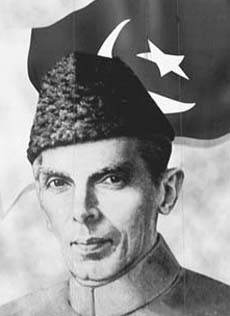
Jinnah was a modern Muslim and a secularist by every definition that one uses to define the word.
He was a brilliant lawyer with a sharp wit, tongue and an even sharper mind. It is true that he was bothered by racial prejudice but it wasn’t simply the racial prejudice towards the Muslims that irked him but it was inequality of any kind. He did not envision a Muslim state for the Muslims but a separate state where they, and people of all religions for that matter, would have freedom of religion. In his inaugural speech as the first governor general of Pakistan he said, ‘You will find that in the course of time Hindus will cease to be Hindus and Muslims will cease to be Muslims, not in the religious sense because that is the personal faith of each individual, but in the political sense as citizens of the state’. He wanted a democratic state but one in which the ‘church was separated from the state’. He was divided on his views. He had to have the vote of the Muslims to gain this state but did he really wish the new country to be an Islamic country? He talked about an Islamic country but the underlying truth is that he never really intended it. Nothing less than religious fervor could have convinced people to support Jinnah en masse for the creation of Pakistan and the subsequent migration to the new country to constitute what has been called the greatest migration in human history.
If Jinnah was a secularist, it was perhaps in his blood and his family background is of much interest in this milieu. Jinnah was born Mahomedali Jinnahbhai on 25 December, 1876, the eldest of seven children of Mithibai and Jinnabhai Poonja. His father was a prosperous Gujarati merchant who had moved to Sindh from Kathiawar, Gujarat shortly before his birth. Some sources suggest that his ancestors were Hindu Rajputs from Sahiwal, Punjab. Though the family had Hindu, Shia, Ismaili and Sunni ancestry his family was primarily Ismaili. Although he was born a Khoja, disciples of the Ismaili Agha Khan, Jinnah moved toward the Sunni sect early in his life and later evidence given by his relatives and associates establishes that he was firmly a Sunni Muslim.
His first marriage was a traditional one when he was barely sixteen to Emibai who was merely a child. She died a little while after the marriage. The second time around he fell in love with a Parsee girl named Rattanbai or Ruttie Petit around 1916. The daughter of Sir Dinshaw Petit, a successful businessman, she was also known as the ‘flower of Bombay’. Needless to say Dinshaw Petit was furious and refused to consent to the marriage as Jinnah was not only of a different faith but also twice her age. Shortly before the ceremony Ruttie converted to Islam and their only daughter Dina was born in 1919. Dina was the apple of her doting father’s eye until she decided to marry the Parsi born Christian, Neville Wadia. It is also known that when Dina married Neville she was told by Jinnah that ‘she was not his daughter anymore’ and the relationship between the two became strained. Dina had two children, a boy and a girl. Her son Nusli Wadia was born a Christian but converted back to Zoroastrianism and settled in the industrially wealthy Parsi community of Bombay.
Though Jinnah died a Sunni Muslim there is little evidence that would insinuate his connection to Islam to the extent that would suggest that his intention in fighting for Pakistan was for the procurement of an Islamic state. His family background, his lifestyle and everything in between only proposes the presence of disparity between the niyyat and the action. The social and political condition of the country ever since it emerged on the map of the world is evidence enough of this hypothesis. Yes he wanted a state that allowed maximum freedom of religious beliefs and practice and treats all its citizens equally. But this ticket and this promise was not enough to rally the Muslims behind him. He had to push the ‘Islamic Country’ theme and he did that relentlessly. Given the fact that he had the support of millions of Muslims of pre-partition India, it is not too difficult to assume that he had not made his plans very clear to the majority of them. This division of thought, of whether Jinnah envisioned an Islamic state or a secular democratic one, still remains the major bone of contention between the millions in Pakistan today.
Dr. Hassan Askari Rizvi, the former chairman of the Political Science Department of the Punjab University, Lahore writes, ‘Jinnah definitely was a secularist who viewed Islam as an instrument of identity formation and political mobilization for the Muslims of South Asia. Whenever he talked of Islam, he also talked about the modern notion of state, constitutionalism, civil and political rights and equal citizenship irrespective of religion or any other consideration. This means that he was neither for a religious or orthodox Islamic state nor for a secular system in the classical Marxist terms. His view was that Pakistan would be modern, democratic state which derives its ethical formation from Islam’.
Dr. Mubarak Ali, former Chairman of the History Dept. at the Karachi University writes, ‘Jinnah used to be a perfect secularist as far as this private life was concerned, (According to Akbar S. Ahmad nearly every book about Jinnah outsides Pakistan mentions the fact that he drank and some sources even hint at his consumption of pork. Several sources indicate that he gave up alcohol only near the end of his life) yet he believed in using religion for public consumption to achieve his political ends. The propelling slogan during the struggle for Pakistan was to establish a distinct identity of Muslims as a nation. And Jinnah used Islam as a motivating force to rally the Muslims to the cause of Pakistan politically. But the state they aimed to create was to be secular, not a theocracy. And the method to achieve the goals was not a religious movement but political agitation’.
In his concluding speech in Karachi at the All India Muslim League session on Dec. 26, 1943 he said, ‘What is it that keeps the Muslims united as one man, and is the bedrock and sheet-anchor of the community. It is Islam. It is the Great Book, Quran, that is the sheet-anchor of Muslim India. I am sure that as we go on there will be more and more of oneness, one God, one Book, one Prophet and one Nation’. One wonders, being so staunch in his ideas for the new country he was seeking for the Muslims why did he not establish Islamic democracy as the rule right from the very beginning? When affairs are run according to the Quran they are automatically democratic. There is no need to specifically separate religion and democracy as was done with Pakistan. Specially when he said in 1945, ‘Every Mussalman (Muslim) knows that the injunctions of the Holy Quran are not confined to the religious and moral duties. From the Atlantic to the Ganges, says Gibbon, ‘the Holy Quran is acknowledged as the fundamental code, not only of theology, but of civil and criminal jurisprudence, and the laws which regulate the action and the property of mankind are governed by immutable sanctions of the will of God’.
Everyone, except those who are ignorant, knows the Holy Quran is the general code of the Muslims’.
So why wasn’t the Quran made the general code when the founder of the country so staunchly believed in it? Whey weren’t these rules made clear from the beginning when they were stated to be the very reason why this new land was sought? Did the niyyat change after the goal was achieved? Was Islam really just an instrument of power to seek the goal at hand? And is it this grave discrepancy in niyyat that Pakistan has forever remained in an abysmal state of political and social chaos? Samuel Butler said, ‘God cannot alter the past, historians can’. Maybe now when people ask questions like, ‘why is all this happening in Pakistan? We thought it is a Muslim country?’ they can be answered with, ‘It wasn’t meant to be a Muslim country, it was only meant to be a piece of land for the Muslims’.
 

Irum,
Great article, sure to provoke a huge outcry!! I took a class here at Yale two years ago that really opened my eyes to this reality. It is quite clear to all historians that Jinnah was far from a ‘practicing’ Muslim; no serious researcher can conclude that he wanted an ‘Islamic’ state. Rather, what he wanted was an independant ‘Muslim’ state to be free from Hindu persecution, but he was quite clearly a secularist. His own writings and speeches are explicit in this point. In fact his conversion to ‘Sunnism’, if it ever happened, was more for show than practice, for as far as we know he was not a praying Muslim (again, as far as his colleagues and friends mention - if he had a double life then that is a separate issue!).
What runs even deeper than this is that many (if not all) of the ‘founding fathers’ of Pakistan (ironically, most of them educated at Oxbridge) did not have this vision (i.e., of an Islamic state) either. Aga Khan III played a major role in the creation of Pakistan, and was in fact the president of the Muslim League for a period; Muhammad Zafrullah Khan, another major player (who eventually became the first foreign minister) was a Qadiani; the Ali brothers, although somewhat religious, did not appear to want an ‘Islamic’ state. Muhammad Iqbal, the poet, died before Pakistan’s creation, and it is difficult to ascertain what type of constituion he would have wanted in a ‘Muslim-run’ country.
Amazingly, Jinnah’s daughet Dina is actually still alive (in New York, it is said?). Sadly, she and her descendants have no relationship with either Pakistan, or the religion of Islam.
Overall, I believe the creation of Pakistan was a positive step for the Muslims of the Indian subcontinent, but at the same time the romantic belief that ‘it was created with the vision of an Islamic state in mind’ is untenable in light of historic evidence.
Yasir
Assalaam Alykum,
I agree with Shaikh Yasir that the people who sold the idea of Pakistan wanted a Muslim state not an islamic state. The problem though is that they sold the Idea of Pakistan to the public as “Islam in danger” and in many of his speech Jinnah used this idiom that the religion of the muslims i.e. Islam is in danger. He used phrases like creating a society like Medina and linking Constitution of Pakistan to sharia. So he surely had a tone which implied that he wanted people to believe that they are fighting for an Islamic state. On the contrary he used to drink, not pray and was not even a Sunni which the majority of Pakistan is.
Also i never understood the role of Aga Khan who is more english than the british was embraced by the Muslim league. He was a major player for sure because of his position with the british. Then you have Muhammad Zafarullah Khan a Qadiani, i mean who can believe this but you see that he was the first foreign minister of Pakistan.
The only people who wanted an Islamic state were the people who were the masses. The comman muslim who stood behind Muslim League and the call for Pakistan were the ones who wanted an Islamic state. The reason i say this is that what moved them into action was not economy or poverty but one single line “Islam is in danger”. They were told that if they lived under hindus they would be persecuted no end and there religion which is there life was in danger. When you create a danger on people identity itself they will surely cling to your call and thats what happened which the Pakistan movement.
I never believed that the leaders of this movement except a few wanted an Islamic state. Most of them never practiced Islam in there own life. One of them was a kafir Qadiani and another is Aga Khan who is again a Heretic/Kaafir. Jinnah himself never practiced Islam in his life then how come he can preach about something he does not do. I mean that is sheer hypocrisy.
The only thing i would say is that creation of Pakistan has hapened and the people behind the creation were the comman muslim who layed there life for its creation. They wanted an Islamic state and thus the people of Pakistan have a golden oppourtunity of making a Islamic state when none exist.
Somebody can correct me if I am wrong historically, Jinnah never wanted a separate muslim/islamic state. He wanted a united India with rights of everyone and decentralized Republic with states having major rights. It was Nehru who with his hinduvata attitude made Jinnah realize that Muslims would be persecuted (as they are in Kashmir, Gujarat etc) under hindu majiroty. So yes his niyyah was clear, and he said it openly (so we should not doubt him), that he wants Pakistan to be a muslim state not islamic state. And honestly perhaps that may solve the issues of Pakistan for time being. Because all the 73 sects of Islam seems to exist in Pakistan. You want Islamic state, how would it look like? Would it be Sunni or Shia or hybrid? If sunni, would it be deobandi. brelwi or Ahle-Hadith?
I think, Pakistan needs to separate church and state, till they get mature enough. When MMA (coalition of islamic parties) controlled NWFP, they did nothing productive just did stereotypical things unfortunately.
Actually Jinnah moved to mainstream Shia (twelver), he never became sunni (according to wikipedia).
I totally agree with the viewpoint that Jinnah had nothing to do with creating an Islamic State he just wanted to create a separate piece of land for the Muslims in fact he was even more tilted towards the idea of having one India with strong autonomous provinces so that Muslims could have strong political representation.
On the other hand the article attempts to answer one question:
“Political, economic stability, education, basic civic amenities, clean water and health is a continuing woe for the vast majority of the 165 million. Why has Pakistan never been able to settle down? ” and continues to say that Pakistan has failed in it BECAUSE the intention of its creation was flawed in other words the intentions were secularist. But what makes you think that a country with secularist intention cannot achieve the criteria of success that you have mentioned ?
I mean all the western countries are based on secularist ideologies and I think they are doing pretty good on things like education, civic amenities, clean water, health or economically
Muslims are the most backward nation militarily as well as economically which ever system they try to put in their country whether secular or Islamic. I don’t really think that the state of Muslims today has to do with they not implementing an Islamic system although I believe as a Muslim it should be one of our lovable things but can we really make it a cause and effect relationship like I think the article is trying to ?
salaam ‘alaikum
sister Irum that was a top writing. As a Bangladeshi Muslim I am always interested in this history. I think your story can further continue up to the the independence of the then East Pakistan that is the now Bangladesh. Sadly this jeopardy of intention continued in Bangladesh where the leaders got it all mixed up with Islam and secularism. The result being is though having a huge muslim population - a secularly educated minority is controlling the state machine. The history of 1971 is always written in a prejudiced partisan viewpoint with no justice whatsoever. That being the case the young generation (including me) can hardly understand what the issue really was. Can you do some writing shedding some light on 1971? It seems like you have good grasp on the history of this part. Plus that you are looking everything with the niyyat behind it - gives me much confidence in you.
keep the good work up. Jazakillahu Khairan.
Excellent writing. I learned a lot.
jazakAllah khair
AS
Assalaam Alykum,
Brother Hassan i think you are confusing things a lot. First of all yes Jinnah was a secularist from the start and nobody contends that. He was opposed to the idea of a spereate state for muslims and was more into a secular united India. When Gandhi emerged into the scene Jinnah found himself sidelined because before Gandhi he was a chief spokesman for Congress. He left India and went back to Britain. After a while he again came back and then started with the new idea of making a new state for Muslims.
Also he agreed reluctantly to have autonomous statehood for muslims in United India. Nehru when became the president of Congress said in his inaugarual speech that muslims state will still be under federal law and there autonomy may be cancelled later on. This gave Jinnah the passage he needed and he started calling for Pakistan.
A pretty important thing which you discounted is why the muslims of India went behind Jinnah. The reason was simple. Jinnah said that there identity which is ISLAM was in danger. So yes the muslims who died and gave there life for Pakistan wanted a Islamic state. Secondly Jinnah when asked what will be the constitution of Pakistan he used the phrase ” Our constitution was written 1400 years ago”. So yes he was either fooling the masses or telling the truth only Allah knows.
Also i would like to say that you should no demean people who are trying to implement Islamic sharia. You are talking as if there had never been an Islamic Khilafa in history or as if Muslim never ruled any part of the world. Muslims have rich history as rulers and have implemented Sharia be they hanafis or shafi or any other madhabs. You are talking as if muslims are monkeys who dont know how to rule according to sharia. Give me a break.
Suhail, MMA = great muslim leaders of past? You are talking like Qazi Hussain is Umar bin Khattab of our time and Maulana Fazlur-Rehman (aka Maulana Deisel) is Umar bin Abdul Aziz of our time. Give me a break yourself.
This was the famous slogan used at the foundation of this ‘Islamic’ Republic. I agree with the author that the ‘masses’ migrated based upon this ‘meaning’ of Pakistan. Considering the hadith mentioned, I am hopeful that the masses will eventually awaken and fix the mess that the bad intentions of the ‘leaders’ has caused. However, looking at the state of the young Muslim from Pakistan and his/her ignorance and disobedience of Allah, I get quite depressed.
I once commented on a blog about the rampant shirk and kufr in Pakistan, and a Pakistani replied with incredibly vulgar language and told me that I was loosing my religion living in Canada while my hijabi sisters where involved in unmentionable relationships. Allahuakbar. I was amazed when I clicked on his profile and read the list of things that have “everything to do with Pakistan” under his favorite activities (music, dancing, flirting with girls etc). SubhanALLah. I seek refuge in Allah from losing my religion and ask him to guide me and him.
I am not defending MMA or any party here. I am making comments to your remark that since there are barelwis, deobandis and Ahlehadith how can we make an Islamic state as if there were no differences among muslim before 19th century.
And there were 100s of rulers after Umar bin Khattab (RA) and Umar bin Abdul Aziz(Rah) who ruled with Islamic sharia with there good and bad. But making a notion that muslims now cannot establish Islamic state is misleading at best.
“ Because all the 73 sects of Islam seems to exist in Pakistan. You want Islamic state, how would it look like? Would it be Sunni or Shia or hybrid? If sunni, would it be deobandi. brelwi or Ahle-Hadith?
I think, Pakistan needs to separate church and state, till they get mature enough. When MMA (coalition of islamic parties) controlled NWFP, they did nothing productive just did stereotypical things unfortunately.”
Here you are telling us that since there are barelwis, deobandis etc what do we do. For your kind information most of the barelvis and deobandis follow Hanafis madhab so you wont have problem with fiqh. Do you mean to say that in the last 1400 years muslims didnt had these divisions. If you think that way then you really need to educate yourself about how much the ummah differed regarding madhabs and other fiqhi issues. Still nobody called for seperation for church and state. You are making it sound like this is a new thing that have cropped up in the ummah.
And your solution to seperate church and state will make the problems go away? LOL who are you kidding.
The problem that Pakistan has is godless politicians with no fear of Allah. That is the core problem not what you are trying to portray. You have corrupt politicians and bureaucracy which is eating the nation wealth. Benazir, Nawaz Sharif, Musharraf, Yahya Khan were not god fearing religious people but hardcore SECULARISTS. They have eaten the wealth of Pakistan and you are blaming the debacle of Pakistan on religion.
Please be fearful of Allah and the last day because you are asking for to remove something which Allah has made fard on a muslim ruler i.e to rule by the law of Allah. Do you think before you speak about Allahs deen? Words are very heavy on scales and light on your tongue so be careful about what you speak unless you get caught on the day of judgement.
Suhail please be fearful of Allah before judging me as well. Thanks.
Here are some valuable comments (dated 05-09-2006) from Sh. Yasir Qadhi on the topic
“Was the Indo-Pak partition worth it?” :
“Salam Alaikum
I haven’t taken Dr. Ashraf’s class but I hope he doesn’t mind my participation!
I personally believe that, while the present Pakistan is far from its initial and ideal goals because of which it was created, it is overall better than living in a Hindu society. At least nominally, Islam is the religion of the state and the religion of the majority of its people. That’s a step forward than being surrounded by idol-worshippers and dominated by openly hostile enemies. Yes, agreed, Pakistani society has a lot of shirk, and for the most part they look down at religious people, but it is still better than blatant shirk and possible danger to life (at times of communal strife).
Also, don’t forget that Quadi-Azam actually came from an Aga Khani background, and was himself, throughout his life, an extremely secular Muslim. So his goal for Pakistan was not the goal of, say, the religious Shawkat brothers, who did much more in the 20’s and 30’s for the establishment of Pakistan than Quadi-Azam did. In fact, even Allama Iqbal was far more religious, and had these primary movers lived to see the fruits of their results and been an active part in the initial shaping of Pakistan, things might have taken a different turn.
To complicate the plot, modern historians are now prone to look at the very establishment of Pakistan in a totally different light. Quadi-Azam (so it is claimed, and quite convincingly if you ask me) never really intended to carve out a new country from India, rather what he wanted was a federalist state and semi-autonomy from a Hindu-dominated government. He would play the ‘Pakistan’ card as a bluff - a threat to scare the British to give him what he had demanded for. To his surprise, some extremely pro-Hindu Indians liked the idea, and of course the British liked it as well, and when his bluff was called there was nothing that could be done. I know, it sounds unbelievable, but read Ayesha Jalaal’s book on the topic, it really changes your perception on the issue.
In any case, what’s done is done, and there is now a ‘pure land’ which Muslims like to call their own (and which happens to be very unpure as well, we were ranked second worst country in the world in terms of corruption). But overall, and as a very unpatriotic ethnic Pakistani (there’s not that much to be proud of!!) I still say that the creation of such a land is far better than living in a Hindu-dominated India.
And hey, imagine living your life without beef Now THAT’S definetly one reason why a Muslim land was sorely needed, and one goal that our pure home land strongly preserved!!
Wa Allahu alam….
Yasir “
I think the creation of Pakistan was a bad idea to begin with… I was born and raised in Pakistan and let me explain why I think it was a bad idea. Muslims that faced the most prejudice were in areas where they made up a minority in India. Most muslims living in lands of what now is Pakistan were always muslim in majority and thus were never really oppressed and marginalised. By creating Pakistan what that did was make life a lot tougher for muslims in present day India. Pakistan was great for people already living in present day Pakistan, but horrible for muslims in present day India. So if infact life became easier for muslim on one hand, it became a lot more difficult for those that were left behind. If Pakistan was still with India, muslims as an aggregate would have a much more stronger voice and would experience a unity amongst them which we never have as Pakistani’s (eg. seperatist movements of pushtuns, balochis, mahajirs)
I just feel that if infact muslims living in Pakistan are living comfortably its at the cost of millions of muslims that now live in India (interestingly there are still more muslims in India then in Pakistan). Muslims in India today make up the poorest of any class.
Actually, there were a number of righteous Muslims who were not for the creation of Pakistan (see Barbara Metcalf’s work on Maulana Husain Ahmad Madani, then principal of the Deoband madrasa). Given the political situation their voices have largely been forgotten, especially by non-Indian South Asian Muslims (e.g. Pakistanis).
I wonder if living as a Muslim under non-Muslim rule is necessarily worse than living in an even nominally Muslim state. From my limited experience, it seems Indian Muslims are much more careful about their Islamic heritage, and more concerned with setting themselves apart from kufr and unIslamic practices, then Pakistanis (I say this as someone who is both Indian and Pakistani, so not trying to offend, just thinking out loud). Even those Indians who are not particularly practicing are proud of being Muslims and look down on haram practices. On the other hand, many Pakistanis, especially the more educated ones, have only contempt for religion and religious folks, and worship Western secular lifestyles to such an extent that they flaunt their drinking and other haram activities as if it’s some kind of badge of honor. It’s a very sad and disturbing situation.
So maybe it’s better for Muslims in the modern day to live as a religious minority, rather than live under a corrupt “Muslim” rule that leads them toward disheartenment with the deen itself. (?)
I apologize if it feels that i judged you brother hassan but some comments by you are not good either you said them intentionally or unintentionally.
I believe that Pakistan was a good idea in itself because living with hindus isnt a good idea to begin with and when you consider them having the upper hand. I am from India but i think if the dream of pakistan was fulfilled and lets pray that it does it is a worthwhile dream. Inshallah things will become better and we should keep praying for the people of Pakistan that Allah give them guidance and they bring the dream of the people who sacrificed there lives for Pakistan to reality. Ameen.
I think discussing whether Pakistan was a good idea is a moot point right now and also discussing Pakistan as a State of Jinnah is also a flawed idea. Pakistan should be discussed in the view what the people of Pakistan think and have gave there life for.
bismillah. it seems that most of us agree there was the niyat of those who led the migration efforts, men who had little or no desire to establish an Islamic state. then the niyat of those who perhaps went only to exploit opportunities. and then the niyat of a third group, the masses who hoped only to leave in salam, as Muslims, in an Islamic land.
may Allah subhanahu wata ala have Mercy upon the legions of Muslims who left behind their homes to travel to what is now Pakistan and Bangladesh hoping to live freely as Muslims. may He have Mercy upon all those Muslims in Bengal, Punjab, Sindh, and other areas that welcomed those muhajir with the love that only a Muslim can have for another Muslim. may He have Mercy upon the Muslims who could not leave or did not trust the reasons given for leaving, and who remained steadfast on their faith in India.
may He guide all of their children to better than what they have now. even those children who left the region altogether seeking security and comfort in far off non-Muslim lands.
it occurs to me that the other day i heard someone say that there was so much strife in Pakistan now that leaving America to return there was not worth the effort. the parents and grandparents of the South Asian Muslims who live now in America, didn’t they live in times of strife? did there families pick up in mass and leave the subcontinent altogether? no.
the difference between the present-day South Asian Muslims of America and the generation of their parents and grandparents (my father emigrated, but he was just a small child, and it was not his decision to make) whether they moved, or whether they welcomed those who moved, or whether they stayed put — is that the Muslims here are all “alone.”
“alone” in that they see the choice as a personal one with only personal consequences. “how can i move my family to Pakistan (or India) now? what will become of us?”
their parents and grandparents may have included people who also thought foremost about their own families. but because all of them had to make the choice at the same time, their actions had collective consequences. and all people had to participate in nation-building at some level. every decision, even if it had a personal motive, was aggregated into a collective outcome.
now if there were some present-day exigency… one that made Muslims here all at once have to decide stay or go… then perhaps it would suddenly not be so hard to imagine living in Pakistan (or India) or any other Muslim country. when Bush was re-elected a lot of non-Muslims left the country. and discriminatory enforcement of laws has driven a few Muslim families in mass out of America… i wonder what another 8 years of GOP rule (”in surges we trust”)could accomplish? heck, even 8 years of Frau Clinton or Mr. Obama? since the article began with a hadith discussing niyat, do you think any of them has a better niyat in mind than Jinnah?
Shaykh Yasir, you’ll be surprised how many people in Pakistan are not fooled by Jinnah. However, most are fooled. As far as I know, Jinnah was what is known as Khoja Shia. My father used to joke that he used to look at Liaquat Ali Khan, his right arm man, while praying because Jinnah had no idea what to do!
Before I say anything, note that I’m not a nationalist, far from it. I’m a regular visitor at the secularist ATP (sister Irum would know) and oppose them not only because they are secularists but becuase they promote nationalism.
I think what brother Suhail says is much more accurate. My own father and grandmother tell me how the masses were completely led to believe that Pakistan=Islam. My father was once awaken by street demonstration in Northern India where people were chanting the very famous slogan all Pakistanis know: Pakistan ka matlab kiya, La Ilaha illlah.
Since nobody knows me here, I’ll tell you that my family was extremely rich in India, had influence where they lived and were religious leaning “wahabis”, but they never once thought Pakistan was a completely wretched idea. My great grandfather and great granduncles were involved in the Muslim League despite of Jinnah at the top.
Of course, the ulema saw through Jinnah and most of them were dead against the creation of Pakistan because they considered, rightly so, that Jinnah will turn Pakistan into a Turkey. Jinnah had a dog named Greywolf, which was a title of Ata Turk, if I’m not mistaken. But, once the scholars saw that creation of Pakistan was inevitable, many decided to come to Pakistan to perserve its Islamic identity and not give Jinnah a free reign. This caused scholars to split (Deobandis split on this issue, ahl-e-hadith split on this issue, etc.) But, both set of scholars had right intentions, inshaAllah. That’s why secularists say that those who called Jinnah Kafir-e-Azam now want to take over Pakistan, and that ulema hijacked the cause of Pakistan, which from their (secularists) prespective is quite true. And, alhamdulillah for that!
So, yes no doubt Jinnah’s and other’s intentions were dirty. Jinnah was a typical two-faced politician: He spoke according to his audience. If he was talking to a country club, he talked about secularism. When talking to masses, of course, he was all about Quran and the shariah.
But, the force behind the creation of Pakistan, the masses, their intentions (most of them) shouldn’t be judged. And, based on this point one can’t say that Pakistanis suffer because of their wrong intentions, which is one of the conclusions of this article. But, the final conclusion is correct that Jinnah wanted a land for Muslims and not an Islamic state. Pakistan is in bad shape, really bad shape, because of thousands of other reasons and not because of dirty intentions of its founding leadership. As Mufti Taqi Uthmani said when Mush. tried to change zina bil-jabr hudood law, “yay hamaray shamat-e-a’maal ka natija hay” (it’s due to our actions (i.e. not sticking to Islam)).
Yes, the pure Islamic state dream for Pakistan was never fulfilled; we never even came close. But, it’s better than living under Hindus, even if only a portion of Muslims of Subcontinent are able to do so. I met a Muslim here who was from Kanpur (Northern India) and he could speak perfet Urdu, but could not read a word of it! And, hence he lost the ability to read a sea of Islamic literature in Urdu. Somehow, he was into Ghalib, the poet, and used to own a copy of Diwan-e-Ghalib in Romanized Urdu!!
Hassan, can you list me a few of the 73 sects that exist in Pakistan, if possible.
The argument that the current condition of Pakistan is in any way relevent to what Muhammad Ali Jinnah believed in ( or more impoortantly not believed in ) is simplistic if not down right naive in my opinion. Even if we go by the main argument in the article, that Pakistan was never intended to be a islamic state, and was doomed from the start due to the niyyah of the founding fathers, one cannot just simply dismiss the pure religious sentiments of the masses behind the movement.
What is the writer trying to imply by quoting a Hadith here ?. that the niyyah of majority of the people was corrupt, OR due to the “corrupt” niyyah ( or hidden agenda )of one/few founding fathers, the punishment has come to all ?. Outrightly discrediting the religious sentiments of millions of muslims like this is very insulting.
The rest of the article then tries to glorify the secular nature of Muhammad Ali Jinnah. This may be convincing if we agree that the legacy of Pakistn is Jinnah, and Jinnah only.
Plus does this ridiculous implication mean anything now. Do tell me what is the academic benefit of such an article ?.
Whenever something goes bad, Why do we Pakistanis always have to pin the blame somewhere. Does that give us closure, so that we can sleep at night thinking that our job is done.
We have been colonized for a very long time and now developed such a defeatist atitude towards life that our affairs are handled by others now. This is the main reason for the mess we are in. If we want to have an Islamic state, then we the people of Pakistan have to do it ourselves.
Let me give you an example:
Though there has always been a public discourse about US running the affairs of our country. This is in one form or another, one topic that people have always talked about.
Unfortunately these words have never been translated into actions either from the civilian governments, or from the general public even in the form of a non violent mass unification/nationalistic/having a unique identity searching movement. Same goes for the election results. Recent election results came as a big surprise to everyone, though everyone knew what the results should be. Every single person was expecting the elections to be rigged. Now please understand how helpless it sounds.
Please rightly blame the majority of Pakistani society for the current mess, and not some dead-for-50 yrs leader. It will not solve anything, and will not provide any benefit for Pakistan.
good stuff.. a lot of history on pakistan i was otherwise unaware of
Atleast I like him , for him we got our independence (Bangladesh ) and for him we suffered a lot too .Our Pakistani Muslim brothers raped thousands of women during the war of 1971 !! that’s some achievement too .
Jazakallahu Khair to Sister Irum and Shiekh Yasir for his comment…
I learnt a lot in that article, and it confirmed a lot of the suspicions I had about my birthplace…
Question is… can anything be done in this case? I mean whenever I think of Dawah whether it be internal or to Non-Muslims, I can always be faintly hopeful or imagine ways of doing so in the majority of countries. But when it comes to Pakistan my mind always screeches to a halt. One on hand you have the secularists who are doing a ‘fine’ job of running the country now and then. Then you have the Muslims spread throughout the country that have some wildly deviated practices, it’s just so hard to find a glimmer of hope there.
I haven’t been there in about 5-6 years, and with Alhamdulillah the changes I have gone through in that period, I’m afraid to go back, simply because I have a feeling that I will feel so alone over there…
I am an Indian Muslim . My naniyal migrated to Pakistan during the Partition . My mother still feels that they were considered more as refujees in Pakistan than considered as even Muslims ! My naniyal was extremely rich with their roots in Bangalore , India . Their wealth & property was taken over by the Indian government & not even a quarter of it was compensated to them when they shifted to Pakistan …. even after having personally know a lot of the top political people of that time in the Muslim league .
Personal hardships aside , what is most destructive is disillusionment .
Pakistan was created by Jinnah with a self-centered interest . As far as my understanding on it goes , Nehru & Jinnah both had wanted to be the FIRST PIME MINISTER of Independent India . Since there cannot be 2 First PMs , it was decided by the egotistical political leaders to tear the mother country into bits & pieces - West Pakistan & East Pakistan , now Bangladesh - even at the expense of millions of lives .
The British , known always to Divide & Rule , had in their hands a tool of vengence . They left behind a legacy - Kashmir is one such a boil on the Indian subcontinent - a place which Nehru loved too much .
If we are taking about Niyaat as per the article written by Irum , then , yes , it has all begun with Niyaath of all sorts of people - of the ones with true self-less intentions like those who lost their lives & livelihood for the cause of Pakistan , as well as of those self-centered people like Jinnah & Nehru who stubbornly wanted each of their ownself to be the FIRST PRIME MINISTER of Independent India .
The less said of Jinnah’s religiosity , the better . His “Muslim” behaviour makes my blood boil . As for his family never respecting their Islamic roots - who is the loser in this ?. It is they - not Islam . We have enough of dead-wood on the Ship of Islam as it is . Moreover , for anyone to be with Imaan or to be blessed with Imaan - the invitation needs to come from Allah .
Jinnah’s present generation may be blessed with all the world’s wealth - but they don’t have that wealth that can be considered the only true wealth - the wealth of Imaan .
Jinnah may have achieved his egotistical desire of becoming a first prime minister - even if not of India - but it could be that it could have come at a heavy price - the price of his soul & that of his family not being blessed with Imaan .
I say the price of his soul , because I believe Allah only values a person’s intentions/Niyaath - and HE is the ONLY ONE who can know the true intentions of anyone .
While I can never judge Jinnah because I can never take the Almighty Judge’s Place , I can though ,or cannot , respect Jinnah . And I choose not to respect Jinnah because I can never respect a person who has no true respect for his Imaan & who can hijack an Islamic cause for his personal gain .
Coming to some prejudiced comments on this blog - being in a Hindu society has not made me lose my Imaan . In fact I can proudly say that people like me are more ” Muslims” than most Muslims of Pakistan whom I find quite superficial & pseudo . I mean no offence to anybody but that is my observation & perception , because you see , when you are a Muslim in a Muslim country much is expected & when not delivered it speaks poorly of that country & its people .I believe there is nothing like Muslim land or non-Muslim land ……being a true Muslim should come from within us . We can’t expect that from Politicians of a country ….. it can come only from its people . Ironically even though Polticians are people , they sometimes think power is everything .
By the way , there is beef sold in my country . Any Pakistani wanting to eat it is most welcome . And it is also Halal .
My point to those with a prejudiced mind - Kindly not clutter your mind with prejudices of any kind . In my humble thinking - I believe prejudices are un-Islamic & can be considered to be Haram . You may ponder over it .
Coming again …..
Could it be that is so because they couldn’t go to Urdu school !!!
I forgot to mention something about the beef in India …..the cattle that produce it - they cannot just not read nor write Urdu , but they cannot speak Urdu either !!
Okay , unholy mirth aside …… one discriminatory comment in this blog regarding the Urdu language in India by one honourable Pakistani referring to some Indians speaking chaste Urdu , but not knowing how to read or write it ……
If I may , can I most humbly refer to our most Noble & Holy Prophet of Islam (peace be upon him) , who could only speak Arabic & recite the Holy Qur’an but who never knew how to read or write in Arabic ……does this make our beloved Prophet ( pbuh) any lesser of a Muslim ?!
Learning a language in all its aspect is good … but not knowing it fully …. can that be considered as inferior ?
I find Pakistanis are quite obsessed with the way Urdu needs to be used , are quite critical of those who may either speak it wrongly or with a local accent & will not hesitate to rudely tick of those like me when I seek refuge in the English language to express myself even though Urdu is also my mother tongue .
The pressures of day to day education in an non-Urdu environment left us with learning the national language (Hindi) , sometimes with the local state language as well , along with the medium of instruction that the British left behind ( English ) .
That is not to say that mothers like mine did not take the effort to teach the mother tongue at home by themselves , since such teachers are rare to come by here , but I remember I learnt to read & write it from my mother at home , but I have also sadly forgotten it
It’s a shame , yes , that I forgot because I feel Urdu is such a beautiful & poetic language ….. but let us not put down those who are not fortunate enough to know it or use it in all its sweet beauty .
asalamualaikum warahmatullahi wabrakatuh,
sister Irum, do you recommend any books for the layman to read to gain more insight into the history of Pakistan?
There’s clearly an array of powers at work creating the case right now for a war on the Pashtun tribal regions. These things don’t just happen in a vacuum. Wars seem to start with the careful choreography of the news media. The war masters, the maestros, start feeding their lap dogs, the press. The music is then played by the press for the rest of us to hear.
Notice how all the papers are beginning to play the same thing about the Afghan and Pakistan border? The theme of “lawless frontier” is being played every week. The sound drowns out the reality of a noble 5000 year old culture of some 42-million people.
We hear instead about the vilified denizens of a “lawless tribal frontier.”
What you missed it? Well, it’s only been playing for about two weeks. You need to tune in to the inside pages. The maestros have been composing for a while longer…. Their creative juices kicked in about the time Sen. Obama, answering one of those deadly sucker-punch sound bite questions showed us his war face telling us he would take action on “high-value terrorist targets” in Pakistan if President Pervez Musharraf “won’t act.
That’s the sunshine it took to start the war-sap flowing. War-sap is sticky stuff, its residue has been known to encapsulate the creatures that get too near and preserve them there for posterity.
There is a legal system in place of course, in this lawless frontier. It’s been there for 5000 years. The Pashtun call the system the jirga. But its not part of the sharia law, it’s unique to the Pashtun and precedes Islam by thousands of years. But we don’t sing about that just now.
Please, I definitely don’t want the Pashtun to start signing their homeland song either. I don’t want to learn that an 1893 border line drawn with the blessing of Queen Victoria divided a group of mountain dwellers along the Afghan and Pakistan boarder in two.
I thought mountain ridges where proper borders. Everybody uses them. I just can’t handle the sound of another this-a-stan or that-a-stan popping up. So please, I don’t want to know about a Pashtunistan. And I definitely have no interest in anything 5000 years old, if it means Obama can catch Osama on good intelligence, bring it on! That should be Commander Obama’s war face call: “Bring it on!” Hmmmm, that sounds familiar.
What is this Pashtuni-whatever, Pashtunwali, anyway?
It’s a code of conduct. The Pashtun openly express somewhat defiantly, total cultural independence and have seen conquering armies and powers come and go through the millennia. Probably because of their original geographic high mountain foothold they could stand off vast armies with terrain advantage. Well it’s about time maybe for all that to stop.
If the Pashtun just hang in there with there non-violent thesis a few more generations, they’ll be the dominant culture of the entire region with the new awakening of intellectual prowess and coming Islamic Reformation which is beginning right now. Their hopes of control over their resources, a name for themselves, and an end to fundamentalist radical Islamic persecution will fade away and they will be the dominant culture. They would be wise to muster whatever assets are needed, magically go find Osama bin Laden and turn him over to the world court thus avoiding a coming war in the tribal area.
And, how come they sound more like American cowboys than foreigners? Darn it, if we are going to start another little war, can’t we start it with some body that doesn’t live like my great, grandfather? The old Pashtun nationalist non-violent Kahn Abdul Gaffari Kahn 1930’s photo, even looks like grandpa!
Setting aside the Pashtun mostly pray to the same God I do, grandpa did, and great grandpa too, how on earth did they adopt the same code as the old cowboy code of the west?
According to “lawless frontier” musical score, the first impressions I hear is Pashtun love rifles, chewing green tobacco, and appreciate a good sense of humor. So what’s not to like? I can’t go to war on that.
If I fell out of the sky and landed in a group of people like that, I’d get along just fine, especially if I were being chased by the law. What they call Nanawateh we call asylum. Nanawateh is extended even to an enemy, just like the Cowboy Code of the Old West. Except if you are granted asylum (called Lokhay Warkawal) by the Pashtun elders as a group you’re in like Flynn! They protect you even if it means forfeiting their own lives. Man that is lawless. Imagine a code of living where a principal was so honored, that it exceeded my duty to the state. Hmmm. Now that is lawless. Isn’t it?
Better to just seek hospitality, then they’ll treat you like a king, which makes me want to open a 5-Star hotel somewhere in the snowy peaks along the boarder if I can find a few acres for a ski-lift not planted in opium poppies, viewed on Google Earth satellite, not that anyone is actually checking the carefully cultivated fields above 6,000 feet along the borders. I would feel right at home there, not unlike parts of Tennessee or California.
Look at the forces arrayed here. My little fantasy war is going to happen.
The Democrats need to show they can be trusted with national defense again, be it Hillary or Obama. And McCain says fight to win.
The second verse of the song is still being written: Floating the contingency balloon. Up, up, and awa-a-a-ay, in my beautiful ball-o-o-o-on….
Obama or Hillary, or McCain get sworn in January 20, 2009. By mid June, whoever is President is going to make a push into the boarder regions the so-called “lawless frontier tribal zones” and “on good intelligence,” unless of course my leader does it first before June 20th. The operation will be Pakistan’s (well okay we’ll give them a few billion). It will be a fast coordinated air-ground attack with airborne US intelligence and lots of surrounding US air cover as a safety check to insure the operation stays within operational parameters. Pakistani’s will not go into Afghanistan and vice a versa. Meantime the Pakistan Navy will be backed up (some would say surrounded and outgunned) by the US Navy to keep a lid on the operation seeing to it they don’t launch an attack on India by Pakistan Islamic fundamentalist-leaning ground forces. We’ll hold India’s hand throughout the entire episode and offer security where needed.
Up, up and awa-a-a-ay in my beautiful …. This thing’s going to happen regardless of who wins.
You can’t deny the poetic justice in someone with a Muslim name (Obama) catching a renegade terrorist (Osama). Can you imagine the songs that we could write about that? To the tune of “Froggy went a courting.”
Obama went a hunting and he did hunt, uh-huh
Obama went a hunting and he did hunt, he hunt Osama on the Mount
Obama went a hunting and he did hunt, un-huh. …..
The best time to wage this little war would be during the Chinese Olympics. China would likely remain quiet with their hands temporarily full with the Olympics.
So my fantasy, glorious, contingency war needs to be brief, violent, and force the Pashtun jirga to rethink their long term cultural interests. It needs to end with Osama in a holding tank, brought up on charges in the world court.
If it fails? Well what do you expect from the lawless tribal frontier area in Pakistan with questionable army allegiance? Corruption is everywhere.
I’d still like to open a 5-star hotel with some good ski-runs. You don’t suppose the opium production their so good at, has anything to do with the foolishness of some of our drug laws? Nah.
Victor Davis Hanson says you have to look at war with a long term perspective in order to understand its meaning. Long term is real long term. It may well turn out that while many say Bush’s legacy must be a failure, history may have a completely different take on things, long after both you and I and our great grand children have come and gone. It may turn out, that doomed legacy of a Bush Presidency we hear so often this campaign-cycle ends up being written 1000 years from now as the President who started Islamic Reformation (* See Footnote) and brought freedoms that enabled thinking people to ask questions about religious practices that eventually changed the world and started the east and the west talking again.
The Ritz, I like that franchise, a 5-star Ritz, 18-hole world class golf course, mini-conference center with A Pashtun bag-piper paying my old favorite, “The Ass in the Graveyard” with double malt scotch, in the bracing night air.
Respectfully - azada wosa,
Warbucks
Footnote: Reformation: “Christianity has the advantage of having been able to interpret its religious texts in their historical context, thus arriving at the distinction between what belongs to the bedrock of faith and what is related to culture: a distinction that Muslims have difficulty making.” … This was a topic of discussion in Muslim and Christian dialogue in Brussels, April 17, 2008. And from Pope Benedict XVI during his visit to the US in April 15-21, while visiting a synagogue in New York, with about 200 representatives of other religions, including Islam, to the Muslims the Pope said that interreligious dialogue “aims at something more than a consensus for advancing peace.” The greater objective of dialogue is “to discover the truth” and keep the deepest and most essential questions awake in the hearts of all men. “Confronted with these deeper questions concerning the origin and destiny of mankind, Christianity proposes Jesus of Nazareth. He, we believe, is the eternal Logos who became flesh in order to reconcile man to God and reveal the underlying reason of all things. It is he whom we bring to the forum of interreligious dialogue. The ardent desire to follow in his footsteps spurs Christians to open their minds and hearts in dialogue…. Dear friends, in our attempt to discover points of commonality, perhaps we have shied away from the responsibility to discuss our differences with calmness and clarity….. The higher goal of interreligious dialogue requires a clear exposition of our respective religious tenants.”
They can solve the “pashtun” issue by giving it back to Afghanistan.
Durand Line is over.
It’s just a cause for conflict later on.
Ask most people in Peshawr and Quetta - I wish there was a survey done, as they see themselves as part of Afghanistan or Pakistan.
(Given there is any stability in Afghanistan in our lifetime with the way the current situation is headed).
ahh the fruits of British Imperialism.
As to the 50 year history of Pakistan is concerned:
What Pakistan was founded upon (a guise of muslim state under secular leader) and what it currently is (?) may give us insight as to the volatile situation it faces.
Muslim by practice - as the vast majority proclaim; and rooted and led through secularism.
Afghanistan border disputes.
Indian threat.
Kashmir unresolved.
Did someone say China? hmm.
Terrorism and coup eminent, - some of it fed by radicalism, other fed by the government policy.
Chaos?
or
aka Fitnah.
“whoever worships Allah during time of fitnah (chaos), it is as if he emigrates to me in Madinah.”
- Muhammad salAllahu ‘alaihee wa sallam.
Walaikum Assalam Daisy
There are countless number of books you can find on the history of Pakistan. It is always good to read a couple to get a good grasp of the picture. The one sitting in front of me is ‘The Indus Saga and the Making of Pakistan’ by Aitzaz Ahsan. You can also try ‘The Great Partitioin: The Making of India and Pakistan’ by Yasmin Khan. Good luck and happy reading!
Disclaimer: Many years ago, as a neo-salafi, I was a Jinnnah basher too and have had long discussions with my dad about him not being true to Islam. But I’ve tempered my views quite a bit since then. I’ll explain why.
First, the point of the article is that Jinnah used ‘Islam’ to grab political power. Well, what personal wealth or privilege did he gain from this, unlike one monarchy in the middle east that has the same claim? But, wait a minute, their country is rich - so their ‘Niyah’ must be pure! As far as being ‘double-faced’ and changing your tune to suit the audience please refer to the interview of Turki-Al-Faisal on Charlie Rose and other Saudi princes to BBC and you will know what ‘double-faced’ really means.
Actually, this article exposes a very basic trait of human nature - which is that we evaluate everything according to Dunya. Now, since Pakistan is a poor/unsuccessful in terms of Dunya, everyone is ashamed to be Pakistani and every Tom, Dick, and Harry can bash Pakistan. But so many ‘Indian’ muslims are ‘proud’ to be Indian these days, aren’t they? Because of what? Because of India implemented Shariah? NO. Because it is now a rich & successful (and therefore respected country). Never mind the atrocities in Kashmir/Assam/Gujrat etc. all powerful countries do that - no problem. Now all those poor souls who migrated to Pakistan wish they hadn’t so they could take advantage of the economic windfall. If Pakistan were economically powerful/successful sister Irum would be quoting the Hadith about how “Allah will aid this religion through the Fussaq of this Ummah” and how Jinnah at least helped in creating a ‘land for the muslims’ where they could live according to Islam blah blah blah…it’s the economy, stupid.
Many of the assumptions in the comments about the ‘general’ masses are incorrect. The vast majority of the ‘general’ masses were never “knowledgeable/practicing” muslims. All they wanted was to make sure they would not have to live under the rule of Hindus. When some Muslim asked Jinnah why Muslims and Hindus couldn’t live together, he said something to the effect of “Son, because you’ve only seen Hindus as colleagues, not masters”. How true. Remember, yahood and hanood share the same traits.
Secondly, being a ‘righteous’ Muslim doesn’t mean that your political judgement/analysis is necessarily correct. Which one of the ‘righteous’ ulama at that time stood up to the British to defend the rights of the Muslims? To speak on their behalf? You need more than a religious education to do that. Jinnah had those tools/qualifications and he used them. And if Jinnah was not practicing, did any of the ulama try to give him Dawah or to educate him? Remember - Muslims had been living under colonialism for more than a century. There were no Islamic insitutions. The madrassahs were relegated to the fringes of society that’s why the vast majority of Muslims weren’t practicing. Remember the story of Bani Israel and how they asked Musa to make a tree for them to worship soon after they were liberated? Anwar Awlaki points out that this is exactly what centuries of living as ’slaves’ does to your mentality. Does anyone seriously expect that Muslims could come out of that situation and create the ‘perfect’ Islamic state? NO. What Jinnah provided was the first stepping stone towards that goal. Now, it was up to the coming generations to use their freedom to develop themselves into better Muslims and the country into an Islamic state step by step. But we didn’t do that - that’s our fault - not Jinnah’s.
At least this is the conclusion i’ve come to. There’s no point in denigrating one man. Practicing or not, he did provide a significant majority of Muslims the opportunity to live freely as Muslims without fear of persecution/harrasment. We did not use that opportunity. Let’s blame ourselves first.
I think nobody is disagreeing with most of the points made here, except the failure to distinguish between Jinnah’s and masses’ intentions, but there are some simplistic assumptions made by commentators. The situation at the time of Pakistan’s creation was complex. The top leaders were secularist, but many other leaders weren’t. And, that’s why it was easy to “hijack” the secularist cause of Pakistan (not fully on govt. level though).
Case in Point: One of Pakistan’s earliest ambassador to UN was Muhammad Asad, the Austrian Jewish convert writer of ‘Road to Mecca’ (not that I fully agree with his ideas…he was quite similar to Iqbal). Second, Pakistan’s first Minister of Education was none other than Sayyid Sulayman Nadwi (rahimu Allah). The first president, Nizamudden, was much different than Jinnah or Liaquat Ali Khan. Jinnah was technically ‘governor general’, not a president. Despite Jinnah and his cohorts, many people from the Khilafat movement joined the Pakistan cause, especially when they saw its creation as a matter of when and not if.
So, the history is complex and the article is too simplistic. Some comments are even more simplistic. Having different sects or shirk/deviancy doesn’t mean that the idea itself was bad, as Shaykh Yasir has mentioned. If that were the case, outside of Saudi most Islamic countries were a bad idea…where is shirk/deviancy not found, unfortunately.
True Virtues: Bro, don’t be naive. If you get a chance, you should go and visit. It’s not like they will eat you alive because you don’t do bid’aat. You won’t know what methods of Dawah to use unless you see the situation first hand or at least take up extensive research on Pakistan.
Sister Esra Tasneem: Part of me thinks that you are answering me based on your won bias and experiences. I didn’t think or implied even a single point you made about Urdu. I’m not an “Urdu-elitist”. The only reason I raised the point was to show that what could happen living under a Hindu rule. And, Urdu in Subcontinent holds more importance because it’s the language in which much of the Islamic literature is found. This doesn’t mean if you don’t know Urdu, you are not a good Muslim…as long as people have knowledge, I don’t care if you learn it through Urdu, English or your ethnic language. But, reality is most Islamic literature is in Urdu. And, the more people know how to read Urdu the more chances for them to learn about the religion.
Shah Waliullah wrote a Persian translation of the Quran, and then was a proponent of Urdu because Muslims all across Subcontinent could understand it. Also, unlike every other language, Urdu is not an ethnic language. Yes, as every Muslim wishes, I also wish that Arabic was widely understood and there would have been no discussion on Urdu. But, facts are facts. And, I’m looking at Urdu as an “Islamic language” in Indo-pak rather than a romantic, poetic, “beautiful” language.
Brother Abu Hafsa
You made many glaring errors in your comment. First of all there were many Ulemas who fought Britishers then you can count on your hand. If you didnt knew that read about the revolt of 1857. Thousands of muslims and scholars were slaughtered in the revolt. When britishers came to India hindus collabarated with them because of there unanimity in hatred of muslims. They both didn’t liked muslims and thus hindus were willing partners with Biritshers except a few.
Also Maulana Abul Kalam Azad fought the britishers just like Jinnah and he disagreed with Jinnah a lot. His khutbah in the Delhi mosque before partition speaks volume.
Jinnah was a very clever and shrewd politician. Nobody can discount that because he was the leader of congress and had great reputation within them. He was a champion of Muslim-Hindu unity at that time. To counter Jinnah soaring popularity within congress Sardar Patel asked Gandhi to come back from South Africa. When he did Jinnah was subdued by Gandhi and he left India. He went to Britain and started practicing law. But he came back after some months and was persuaded by others to join Muslim League. If you read history you will find how Jinnah was a staunch secularist. I am not discounting his effort to make Pakistan but still he was what he was.
Also when you defend Jinnah religousity and why Ulema didnt gave him dawah. Are you for real? I mean how do you know that the Ulemas didnt. He was s Ismaili Shia and then said to convert to Ithna Asharriya. He never prayed, drank a lot and stuff. I mean can you categorize a person such as this as Muslim. Forget Jinnah if a certain person repeats this until his death and never repents of his behavior then what will you say about such a person.
I think it will take time for Pakistan to mature and will it become a Islamic state then only Allah knows best. We can just make dua.
Thanks Br. Suhail for pointing out some of the misinformation included in Abu Hafsa’s post. There were many righteous Muslims, including top ulama, who did not support the formation of Pakistan, most likely because of the negative effect it would have on the majority of Subcontinent Muslims, who would *not be able to leave*. As you can see from even the anecdotal stories above, many of the people who made it to Pakistan were the elite and wealthy, who could afford to pick up and go somewhere else.
And there were Islamic institutions that existed in India at the time, both old (Farangi Mahall) and young (Deoband). The latter was especially effective in “getting the message out”. It’s top scholars did do da’wah to Jinnah. Just because people were experiencing weakness of faith doesn’t necessarily mean it was due to the incompetence of the ulama (that would be what the British especially would want us to believe). The deen and its inheritors (the ulama) were strong, will always be due to the promise of Allah to preserve the message. Modern-day Muslims have spiritual weakness due to a whole number of factors (and we should not fall into the “glory days fallacy”–pre-modern Muslims were also not all from the saliheen).
I did appreciate Abu Hafsa’s point about us being deluded by material success: we can bash on Pakistan because it is politically and economically weak, but not on “the other state” just because it’s doing better dunya-wise. This is a serious delusion we need to realize and face. Still, if we can avoid such wrong-minded thinking, we can still see that there are serious religious-structural problems in both states…
Suhail & passerby,
1. 1857 was *100* years before the time we’re talking about.
2. The political opinion of someone like Abul Kalam Azad doesn’t make his opinion the ’shariah’ or the ‘correct islamic’ position. It is a matter of Ijtehad. So his position was that all the muslims should live under the subjugation of Hindus? Why does everyone think that is a good idea? Oh - I see - because they are our big brothers now - if we did we wouldn’t have to bear the shame of carrying a green passport with ‘Islamic Republic of Pakistan’ written on it. If someone in New York asked me where I was from I could proudly say ‘India’ instead of that nastly old poor lawless jungle in the dark ages called Pakistan (or may be some of us do that already?!). Why were the Muslims who wanted to go to Pakistan massacred by our firendly big brother Hindus & sikhs in the first place? Wow, imagine living under such nice people, right? Any Muslim from Gujrat care to second that, please?
3. It is not true that the rich and the elite were the ones who migrated to Pakistan. Most of them were poor. Please brush up on your history. And even if they were rich and elite, so what? Does that make their immigration less credible?
4. I would like someone to give me a single, authentic anecdote where a reputable scholar tried to meet with Jinnah, or wrote him a letter, explaining to him his obligations as a Muslim. How is his case any different from the millions of Muslims in Pakistan who fast and go to Hajj but do not pray because they are ignorant of the ruling of Salat? And this is NOW. Imagine just coming out of occupation! I am not trying to make excuses for him, Allah is the one who will judge him. BUT please consider his family background, his bringing up, his circumstances, his educations, his ignorance.
5. I would like everyone to PLEASE carefully read the FIRST constitution of Pakistan and tell me that this is the constitution fo a ’secular’ state:
Source: http://pakistanihistory.com/archives/49objec.htm
The Objectives Resolution
In the name of Allah, the Beneficent, the Merciful;
WHEREAS sovereignty over the entire universe belongs to God Almighty alone and the authority which He has delegated to the State of Pakistan through its people for being exercised within the limit prescribed by Him is a sacred trust;
This Constituent Assembly representing the people of Pakistan resolves to frame a constitution for the sovereign independent State of Pakistan;
WHEREIN the State shall exercise its powers and authority through the chosen representatives of the people;
WHEREIN the principles of democracy, freedom, equality, tolerance and social justice, as enunciated by Islam, shall be fully observed;
WHEREIN the Muslim shall be enabled to order their lives in the individual and collective spheres in accord with the teachings and requirements of Islam as set out in the Holy Quran and the Sunna;
WHEREIN adequate provision shall be made for the minorities freely to profess and practise their religion’s and develop their cultures;
WHEREBY the territories now included in or in accession with Pakistan and such other territories as may hereafter be included in or accede to Pakistan shall form a Federation wherein the units will be autonomous with such boundaries and limitations on their powers and authority as may be prescribed;
WHEREIN shall be guaranteed fundamental rights including equality of status, of opportunity and before law, social, economic and political justice, and freedom of thought, expression, belief, faith, worship and association, subject to law and public morality;
WHEREIN adequate provision shall be made to safeguard the legitimate interests of minorities and backward and depressed classes;
WHEREIN the independence of the judiciary shall be fully secured;
WHEREIN the integrity of the territories of the Federation, its independence and all its rights including its sovereign rights on land, sea and air shall be safeguarded;
———————————————————
Believe me brothers, there was none of this talk of ‘was partition a bad idea’ when Pakistan & India were neck-and-neck in terms of military, finance, and prestige up to the 70s and mid-80s. There was a time when the standard of living of the avg. Pakistani was much better than the avg. Indian. There used to be no ’street’ ppl in Pakistan in the 70s & 80s while millions in India lived on the streets. Then , no Pakistani ever harbored the thought that independence was a bad idea. Now, everyone wants to jump from the sinking ship onto the bigger one. Some under the guise of Islam, others under the guise of ‘progress’, others under the guise of ‘Hindu-Muslim’ brotherhood. All different facades to the same basic human trait I mentioned earlier.
Sorry, missed one point:
Maulana Abul Kalam Azad (Rahimullah) was a member of the All India Congress. How did he exactly ‘fight’ the British? Please enlighten me.
Here’s how:
“Azad was one of the main organisers of the Dharasana Satyagraha in 1931, and emerged as one of the most important national leaders of the time, prominently leading the causes of Hindu-Muslim unity as well as espousing secularism and socialism. ”
source : http://en.wikipedia.org/wiki/Abul_Kalam_Azad
Perhaps this will help:
“Azad was one of the main organisers of the Dharasana Satyagraha in 1931, and emerged as one of the most important national leaders of the time, prominently leading the causes of Hindu-Muslim unity as well as espousing secularism and socialism.”
Source: http://en.wikipedia.org/wiki/Abul_Kalam_Azad
Abu Hafsa it’s very nice to see how patriotic you are for the state of Pakistan. May Allah swt bless you for your love of your people and country. You don’t have to like that some scholars (I wasn’t talking about Azad, Suhail was) did not support the formation of Pakistan. But you can’t deny it. Also, I’ve read clear references of ulama who had written to Jinnah (and he had even written them back). I can’t recall the citations right now but anyhow the point is moot; he’s dead and one has to wonder I guess like you and others do above about what relevance his religiosity or lack thereof has for us today. (However Sr. Irum does make some interesting points about its eventual repurcussions.) May Allah guide us all, the people of both Pakistan and India and elsewhere. Each of the former two groups have their own unique problems. Wassalam. p.s. I am not a “brother”.
passergby,
Seriously, I am not patriotic at all. My friends, parents, and family will testify to that.
What I don’t like is double standards. While it’s fashionable for practicing Muslims to criticise Jinnah for being ’secular’ despite the fact that he refused to be ‘led’ by Hindus, and for better or worse, created a state where they had the opportunity to establish an ‘islamic’ state (Please refer to the Objectives Resolution above), while on the other hand we have Abul Kalam Azad who accepted Gandhi and Nehru as his leaders, and served in their *secular* governments as a minister, and he doesn’t get any flak for being ’secular’? Why because he is a ‘maulana’? I just don’t get it.
I don’t agree with the premise of the article that the ’cause’ of Pakistan’s failures is *because* of Jinnah’s lack of proper Islamic practice and credentials. He did what he could do. I believe that at some point he realized that if the muslims lived under the rule of Hindus their religious identity would be diluted after several generations. For example, the indian goverment makes it easier for muslim girls to get higher education in state colleges but not muslim boys. The result is that many muslim girls are now marrying hindu boys because of lack of ‘comaptible’ options. Unfortunately, many muslims don’t realize how shrewd and cunning hindus are. Perhaps Jinnah was intelligent enought ot relaize that.
The point is, did the ulema and the practicing muslims avail of the opportunity they were given in the shape of a country where they were free, by law and the constitution, to establish and practice Islam, and engage in dawah without any hindrance from the state? A point to ponder.
Please provide me with the citations for “clear references of ulama who had written to Jinnah”. I would appreciate that very much.
P.S Since the gender of posters is not disclosed on this forum, any use of ‘brother’ should be implicitly understood to mean ‘brother/sister’ as appropriate.
Abu Hafsa, first of all being a salafi has nothing to do with loving/hating Jinnah. Deobandis call him Kafir-e-Azam mocking the title given to him, Qaid-e-Azam. It’s about who is aware of Islam and knows about Jinnah.
As I said above, scholars were against the creation of Pakistan mainly because of fear of what Jinnah will do to it. But, when its creation seemed inevitable, some scholars ijtihad was to go to Pakistan and try to resist Jinnah’s ideology, and some didn’t want anything to do with Jinnah and wanted to safeguard the rights of those who were to be left in India. Hence, many stayed behind; one of whom was Abul Kalam Azad, and also Abul Hasan Ali Nadwi. Did it make Abul Kalam look like an Indian nationalist? Yes, and some of his actions I didn’t like either. But, I know for sure, as I’ve read and listened to Nadwi, that at least Nadwi stayed behind to help out the remaining Muslims and the madaaris. Interestingly, I’ve heard Shaykh Nadwi say something like we need secularism in India, but in his books and when he came to Pakistan in 1980’s, he talks against secularism. So, you need to understand the context of those scholars who stayed in India. Remember, Muslims were and are in minority in India.
My experience has always been that religiously concious people have no two opinion about Jinnah, more or less. Most do not consider him a practicing Muslim. You might ask why didn’t (or don’t) scholars call Jinnah out? The answer is they did, pre-partition. Post-partition, they felt that since the masses had been fooled by Jinnah’s “message of Islam”, it was better to not yell about Jinnah but tap the passion of the masses that allowed Jinnah to fool people in the name of Islam and shariah.
And, you say as if Jinnah was a lone ranger in creating Pakistan! He came to the scene exactly when? Late 1920’s when he responded to Nehru. He only became president of Muslim League in 1934, I think. Jinnah could do all his talk and be a clever politician, but if the masses didn’t want a separate Muslim country, no person could have forced them to fight for it. Nobody is talking about the knowledge/taqwa of the masses in general, but their sentiment for a Muslim country and their intentions were different than Jinnah’s. Jinnah played to the religious sentiments, and that’s all. No one prominent scholar I know consider Jinnah any good. Give me your email address and a couple of weeks and I can produce quotes of Jinnah that are 180 opposite to each other. The only difference: When he talks secularism, his audience is some “gymkhana” (~country club) and when he talks about Allah, His rasool, Quran and Shariah, his audience is the masses. Don’t just read history; analyze it and you’ll see inshaAllah.
Assalamoalikum.
Muhammad Ali Jinnah has been painted as a political maestro who though having a strong secular ideology, was able to gather and mobilize millions of Muslims ( practicing or not ) into creating a country in the name of Islam.
First of all I want to emphasize that MA Jinnah was not the architect behind this idea. He made it a political reality later on, but the whole idea of Muslims having a separate homeland was first formally presented as “Two nations thoery” by Allama Iqbal. MA Jinnah being depressed at his failure to bring Muslims and Hindus together had gone and settled in England. Remember he was used to be called as “an ambassador of Hindu Muslim unity”.
This is a fact accepted as true by most respected historians and journals in the world. This snippet directly from encyclopedia Britannica
“The proposal for a Muslim state in India was first enunciated in 1930 by the poet-philosopher Muhammad Iqbal, who suggested that the four northwestern provinces (Sindh, Balochistan, Punjab, and the North-West Frontier Province) should be joined in such a state. In a 1933 pamphlet Choudhary Rahmat Ali, a Cambridge student, coined the name Pakstan (later Pakistan), on behalf of those Muslims living in Punjab, Afghan (North-West Frontier Province), Kashmir, Sind, and Balochistan. Alternatively the name was said to mean “Land of the Pure.””
Later in the article it is mentioned:
“The gradual clarification of the British intention to grant self-government to India along the lines of British parliamentary democracy aroused Muslim apprehensions regarding ultimate political subjection to the Hindu majority. Mohammed Ali Jinnah, as eager as any Hindu nationalist to bring British rule to an end, was at length driven to the conclusion that the only way to preserve Indian Muslims from complete subordination to the Hindus was to establish a separate Muslim state. By 1940 the demand for Pakistan had been formally endorsed by the Muslim League under his leadership.”
Also: @ Br. Abu Hafsa
I would appreciate if you can elaborate a bit more on the “majority of general masses not being knowledgeable/practicing Muslims” comment. How does one define some one to be knowledgably and/or practicing Muslim?
The reason I brought this the following: If this statement is true, and the idea of Pakistan did not appeal to the Muslims on religious lines, then this effectively negates the whole argument in the article that MA Jinnah somehow manipulated religious sentiment. There is an inherent fallacy in your argument.
Let me put it in another way:
Slogans shouted at political rallies are usually good indicators of how ordinary people relate to the ideology of a politician. Case and point being the famous slogan of Bhutto: “roti, kapra, aur maqan”.(food, clothing and roof )
Slogans used by Muslim league during the rallies leading to the independence of Pakistan had very strong religious content, even utilizing the core philosophy of our religion: “Pakistan ka mutlab kya, La illaha IllaAllah.”
I can accept the most of the people involved in the movement may be naïve to the political ambitions of the leaders, but I will again defend their primary intentions for the struggle. It was never economics, or any other secular ideal, it was primarily for their belief and protection of their religious identity.
Some commentators have also pointed out the disagreement of scholars of that time. This topic has been brought up in front of my elders and some of the reasons given to me by people living at that time are:
1. Division of India will cause a lot of unnecessary bloodshed.
2. Division will effectively reduce the political influence of muslims in India.
I totally agree on both points as being very valid, and do not want to discuss these more.
And please in the name of Allah, stop bashing the past trying to get some reason for our current failures. Use your intellect in dealing with the problems of the present.
@AHannan
> would appreciate if you can elaborate a bit more on the “majority of general masses not being knowledgeable/practicing Muslims”
> comment. How does one define some one to be knowledgably and/or practicing Muslim?
I will attempt to elaborate:
A Practicing muslim:
1. Knows tawheed from shirk
2. Establishes the 5 pillars practically in daily life
3. Avoids the haram & the major sins - cares about how he earns his money
4. Enjoins the good, forbids the evil
5. Tries to implement the Quran and Sunnah in his daily life - especially in regards to those areas he is obligated
6. Strives with his wealth and life in the way of Allah (SWT)
7. Believes that all affairs of life should be ruled by Shariah
A Non-practicing muslim:
1. Identifies himself as belonging to the Muslim Ummah and has uttered the shahada. Accepts and loves the Prophet (SW) as the final messenger.
2. Is circumcised (men)
3. Attends Eid prayer regularly and Jumuah salat once in a while. Does not pray the 5 prayers regularly.
4. Conducts rituals of marriage, divorce, birth, death etc. Islamically (aqeeqah, waleemah, nikah, janazah) etc. Will not marry a hindu. A woman will not marry a non-muslim.
5. Is burried Islamically and in the Muslim’s graveyard
6. Probably distribute his wealth Islamically in his waseeah
7. Is ignorant/heedless about many aspects of shariah in daily life.
> I totally agree on both points as being very valid, and do not want to discuss these more.
You’re definitely entitled to your opinion.
And then were some “scholars” like Ahmed Rida Khan:
Source: This is Barelvism
Religious practice and religious sentiment are two different things. Sentiment can entail having an attachment to common labels and certain key aspects (we don’t eat pork, we pray eid) vs I want a shariah-compliant state with the Hadd implemented, ie let’s create a state in which Islam can be implemented.
Siraaj
“AHannan said:
…………………………………………………..
First of all I want to emphasize that MA Jinnah was not the architect behind this idea. He made it a political reality later on, but the whole idea of Muslims having a separate homeland was first formally presented as “Two nations thoery” by Allama Iqbal.”
Akhi to my knowledge the founder of the “Two nations thoery” is not Allama Iqbal, rather it is Sir Syed Ahmed Khan.