
Uncategorized
Organ Donation: Something to think about?

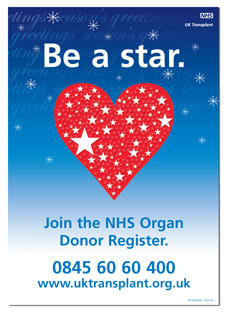 Recently, the UK PM, Gordon Brown, proposed that in order to tackle the problem of organ donor shortages, the current “opt-in” system should be replaced with an “opt-out” one, whereby all British citizens would automatically be placed on the donor register, unless they objected during their lifetime, or their family members refused permission after death. The “presumed consent” proposal has been welcomed by some, and rejected by others, including several patient groups.
I’d almost forgotten about the issue, until I came across this comment by Lord Sheikh, in a House of Lords debate on the Kidney Transplant Bill:
To my knowledge, the five major faiths in the United Kingdom do not object to the principle of organ donation. Christians, Jews, Muslims, Hindus and Sikhs have all endorsed organ donation and transplantation… My understanding is as follows.
A Christian who chooses to donate an organ is following the example set by Jesus of demonstrating love. Sacrifice and helping others form a key part of Christianity and, in the Bible, Christians are invited by St Matthew to “freely give”.
Jews are required to obtain consent from a competent rabbinic authority before any organ donation procedure can commence, but nothing in principle in Judaism conflicts with organ donation in order to save lives. Jewish law prevents the unnecessary interference with the body after death and requires immediate burial of the complete body.
In Islam, violating the human body is normally forbidden, but it is permitted to save another person’s life. Indeed, the Holy Koran states in chapter five that, “whosoever saves the life of one person it would be as if he saved the life of all mankind”.
“Daan” is a word in Sanskrit for donation, which means selflessly giving to a Hindu. That is the third of the 10 niyamas, which are virtuous acts of the faith. Actions that sustain life are accepted and promoted as dharma, which means righteous living. Hindus believe that the soul is invisible, and that it is wrong to grieve for the body.
A key feature of Sikhism is the requirement to put the needs of others ahead of one’s own requirements. As with most of the other religions, the soul of an individual is separate from the physical body, and Guru Nanak taught, in the Guru Granth Sahib, that: “The dead sustain their bond with the living through virtuous deeds”.
Discovering this “common ground” between five very different religions, made me realise that, as a Muslim, I’ve never really thought much about the idea of becoming an organ donor before. I had some inkling that it was permissible in Islam, but had not yet embarked upon a serious quest to decide whether or not I should carry a donor card. In light of this recent debate, and the fact that I don’t know how long I have left on this Earth, I think it is about time that I did.
Keep supporting MuslimMatters for the sake of Allah
Alhamdulillah, we're at over 850 supporters. Help us get to 900 supporters this month. All it takes is a small gift from a reader like you to keep us going, for just $2 / month.
The Prophet (SAW) has taught us the best of deeds are those that done consistently, even if they are small. Click here to support MuslimMatters with a monthly donation of $2 per month. Set it and collect blessings from Allah (swt) for the khayr you're supporting without thinking about it.
So, what does Islam really have to say about organ donation? Referring to Sheikh Google, I discovered a leaflet published by the NHS Transplant website titled “Islam and organ donation“, which states:
One of the basic aims of the Muslim faith is the saving of life. This is a fundamental aim of the Shariah and Allah greatly rewards those who save others from death.
Violating the human body, whether living or dead, is normally forbidden in Islam. The Shariah, however, waives this prohibition in a number of instances: firstly in cases of necessity; and secondly in saving another person’s life. It is this Islamic legal maxim al-darurat tubih al-mahzurat (necessities overrule prohibition) that has great relevance to organ donation.
“Whosoever saves the life of one person it would be as if he saved the life of all mankind.“ Holy Qur’an, chapter 5 vs. 32
[…]
Muslim scholars of the most prestigious academies are unanimous in declaring that organ donation is an act of merit and in certain circumstances can be an obligation.
These institutes all call upon Muslims to donate organs for transplantation:
- the Shariah Academy of the Organisation of Islamic Conference (representing all Muslim countries)
- the Grand Ulema Council of Saudi Arabia.
- the Iranian Religious Authority
- the Al-Azhar Academy of Egypt
In addition, according to a fatwa on Islamonline.net:
“Organ donation is permitted in Islam if it is done within the permissible limits prescribed by the Shari`ah.
The following are the conditions scholars have stipulated for donation:
Conditions associated with a living donor:
1. He/she must be a person who is in full possession of his/her faculties so that he/she is able to make a sound decision by himself/herself;
2. He/she must be an adult and, preferably, at least twenty-one years old;
3. It should be done on his/her own free will without any external pressure exerted on him/ her;
4. The organ he/she is donating must not be a vital organ on which his/her survival or sound health is dependent upon;
5. No transplantation of sexual organs is allowed.
Conditions associated with deceased donors:
1. It must be done after having ascertained the free consent of the donor prior to his /her death. It can be through a will to that effect, or signing the donor card, etc.
2. In a case where organ donation consent was not given prior to a donor’s death, the consent may be granted by the deceased’s closest relatives who are in a position to make such decisions on his/her behalf.
3. It must be an organ or tissue that is medically determined to be able to save the life or maintain the quality of life of another human being.
4. The organ must be removed only from the deceased person after the death has been ascertained through reliable medical procedures.
5. Organs can also be harvested from the victims of traffic accidents if their identities are unknown, but it must be done only following the valid decree of a judge.”
But what about the permissibility of donating organs to non-Muslims? Islamonline.net says:
Islam is a universal message of love, mercy and compassion towards all the inhabitants of this globe. It is because of this that it permits a Muslim to donate an organ to a non-Muslim in case he/she is in need. Of course, priority is given to a Muslim in case the donating Muslim is offered the choice.
So, thus far, it seems that there is little stopping me from adding my name to the organ donor register. In fact, another answer suggests that I might be dumb not to:
“Organ donation to save the life of another or to help another lead a better life is considered a meritorious act that entails great rewards. This has been the view of the Islamic jurists who have discussed this issue. The Prophet (peace and blessings be upon him) told us: “Whosoever of you can render any benefit to his brother should do so.” It is not hard to imagine that no benefit is greater than saving someone’s life by giving him the gift of an organ or tissue donation. Therefore, this would fall under the category of a most charitable act.
Organ donation is also reckoned as a sadaqah jariyah (ongoing charity) from which the donor will continue to reap rewards after his/her own death, so long as the organ he/she has thus donated continues to function in the body of another human being.”
After reading all this, and especially considering that my own ethnic group is in dire need of more donors, I strongly suspect that it becomes my Islamic duty to register asap.
I encourage everyone to think deeply about becoming an organ donor; discuss the issue with trusted knowledgeable people, and most importantly, with your next of kin, because, in UK law at least, organs cannot be harvested if any close family member objects, in spite of any consent given by the deceased during their lifetime.
To find out more about what it means to be a registered organ donor in the UK, please refer to the NHS FAQ. If you have already made your decision, you can even sign up online. I invite readers from other countries to deposit the relevant info for how to become a donor in their locality, in the comments section below.
Finally, I ask Allah to forgive me for any errors I have made in writing this entry, and ask for guidance on this crucial topic, which has the potential to earn such great rewards. Ameen.
Keep supporting MuslimMatters for the sake of Allah
Alhamdulillah, we're at over 850 supporters. Help us get to 900 supporters this month. All it takes is a small gift from a reader like you to keep us going, for just $2 / month.
The Prophet (SAW) has taught us the best of deeds are those that done consistently, even if they are small. Click here to support MuslimMatters with a monthly donation of $2 per month. Set it and collect blessings from Allah (swt) for the khayr you're supporting without thinking about it.





[Podcast] Palestine in Our Hearts: Eid al-Fitr 1445 AH

Foreign Affairs Official Resigns Over Gaza Genocide

A Ramadan Quran Journal: A MuslimMatters Series – [Juz 30] Solace For The Sincere And Vulnerable

IOK Ramadan: The Importance of Spiritual Purification | Keys To The Divine Compass [Ep30]
IOK Ramadan: The Power of Prayer | Keys To The Divine Compass [Ep29]

IOK Ramadan: 7 Qualities of Highly Effective Believers | Keys To The Divine Compass [Ep18]
IOK Ramadan: Choose Wisely | Keys To The Divine Compass [Ep15]
IOK Ramadan: Shake the Trunk of the Tree | Keys To The Divine Compass [Ep16]
IOK Ramadan: They Were Not Created Without Purpose | Keys To The Divine Compass [Ep23]
IOK Ramadan: Appreciating the Prophet ﷺ | Keys To The Divine Compass [Ep22]
IOK Ramadan: The Importance of Spiritual Purification | Keys To The Divine Compass [Ep30]
IOK Ramadan: The Power of Prayer | Keys To The Divine Compass [Ep29]
IOK Ramadan: The Weight of the Qur’an | Keys To The Divine Compass [Ep28]
IOK Ramadan: Families of Faith | Keys To The Divine Compass [Ep27]
IOK Ramadan: Humility in Front of the Messenger | Keys To The Divine Compass [Ep26]
-

 #Islam2 weeks ago
IOK Ramadan: 7 Qualities of Highly Effective Believers | Keys To The Divine Compass [Ep18]
-
#Islam2 weeks ago
IOK Ramadan: Choose Wisely | Keys To The Divine Compass [Ep15]
-
#Islam2 weeks ago
IOK Ramadan: Shake the Trunk of the Tree | Keys To The Divine Compass [Ep16]
-
#Islam2 weeks ago
IOK Ramadan: They Were Not Created Without Purpose | Keys To The Divine Compass [Ep23]
Yasir Qadhi
January 20, 2008 at 4:51 PM
Salaam Alaikum
Great issue to highlight, and one that we need to discuss openly.
My main concerns would be:
1) How do we know or control what will be done to those organs after we die? Can we guarantee that it will be used in a patient for a life-threatening situation?
2) Is it true that cadavers that are used in med schools are also supplied from the very same pool of people who ‘donate their organs’ to science? If this is the case then one really needs to ask himself/herself: do you want a group of inexperienced med students gawking and groping your dead body, sawing bits and pieces off for there mid-term homework?
3) Our eschatological beliefs of the after-life tells us that angels question us at the point of burial, and then the souls experience pleasure or punishment in the grave itself. No doubt those bodies that are somehow deprived of a burial due to circumstances beyond their control (e.g., drowning) will be an exception that God will deal with in His power, but the question is: should a person willingly ‘give up’ his body and a shot at a decent burial? The Shareeah places an obligation upon us to respect a dead body, for a hadeeth states, “Breaking the bones of a Muslim’s corpse is as if one broke them while alive.”
I’m not saying that organ donation is prohibited; it is clearly not. My concerns are with the Islamic conditions coupled with the reality of the medical systems around us.
Allah knows best…
Afia Baig
September 15, 2014 at 1:18 AM
Walaikumassalam wr
By law at least in the western world an organ can only be used for the purpose it is donated to Also donors can place any condition they want on their donation after death for example the condition of only women doctors looking at or handling a Muslim women cadaver ,and by law the conditions have to be met .At the moment these conditions can be written in the will or mentioned to family members as by law organs are not taken witIhout having a conversation with the family. i have personally asked all these questions to the relevant people Thus the organs are not donated to science but to save life of another in need of it Further a person is listed for a transplant only when his/ her survival depends on it i know these facts by having a medical background and being a mother of a child waiting for a transplant
jazakallahukhiarn
iMuslim
January 20, 2008 at 5:20 PM
Wa ‘alaykum salam wa rahmatullah
Great questions. I think it is best to consult your own transplant authority to answer some of them.
For those in the UK, the NHS website says:
So it seems that donating your body for organ transplantation does not automatically mean it will be used for scientific research, and that the body will be returned for burial soon after the operation, insha’Allah.
One point i have just read about in the FAQ, that needs to be addressed:
Although we are allowed to donate organs to non-Muslims, I have read a clause that says organs cannot be given to anyone fighting against the Muslims. So i would think “members of Her Majesty’s forces serving abroad” would be a big no-no, right?
Pingback: Organ Donation: Something to think about? « iMuslim
Shahrzad
January 20, 2008 at 7:02 PM
Organ donation in Iran is very common. I wrote an article about it here:
http://shahrzaad.wordpress.com/2007/11/05/when-brain-dies/
I am also member of the organ donation institute. Mean if i get brain death, they’re allowed to use my organs. Anyway there is this condition that parents must accept it after brain death.
I think it is good act. Based on :
“And if any one saved a life, it would be as if he saved the life of the whole people.(5:33)”
mcpagal
January 20, 2008 at 7:12 PM
“2) Is it true that cadavers that are used in med schools are also supplied from the very same pool of people who ‘donate their organs’ to science? If this is the case then one really needs to ask himself/herself: do you want a group of inexperienced med students gawking and groping your dead body, sawing bits and pieces off for there mid-term homework?”
I understand that in the UK (or in Scotland at least) donors for medical school etc have to opt into a system and actually volunteer themselves to be used for teaching after they die. Plus I wouldn’t underestimate the benefits: yes the students are inexperienced but I’d rather they got their experience dissecting cadavers than starting with surgery – apparently a lot of the donors feel (well, felt) positively about helping train the next generation of doctors.
We had a talk from the organ donation service when in school, I think they said that donors have to have died a brainstem death, like if you’re in a car accident and get turned into a vegetable? I’m not sure on that though.
The thing about donating to some people and not others… I would hate to think of my liver going to some alcoholic who’ll probably just go ruin it. There’s no way around it though really, is there?
Anyways, I think this was a great topic to bring up. Loads of Muslims would be perfectly happy to accept donated organs that would save their lives, but don’t even consider donating. Same goes for blood.
Give blood!
Irum Sarfaraz
January 20, 2008 at 9:40 PM
With due respect to the opinion of all those who have written the post and the ones commenting on it, my personal stand is that our body is the amanah of Allah and not ours to ‘give’ away at our discretion. Whatever a Muslim can do whilst still alive to save the life of others, he or she should do but after the soul has been taken, he or she has no right to further use his or her body or its organs according to their desire or wish. Wallahu Alam.
Organic Muslimah
January 21, 2008 at 12:28 AM
Great post! I agree with you, so long as my body won’t be used to experiment on. I will donate my organs for a good cause. It wouldn’t matter to me anymore, I will surely be in a better place, God-willing!
Dawud Israel
January 21, 2008 at 1:42 AM
Great post…
There is a book that I would encourage you to read, if I remembered the name of it…regarding donating your body to “science” (not necessarily organ donation) since it is related.
In short it’s research about how donating your body to medical science doesn’t mean it will be used to save lives. Some end up being used for hair stylist school or worse in cosmetology (cosmetics!). Other bodies end up being used for military uses in testing firearms and practice (i think) for soldiers.
Yeah, desensitization sucks.
Dawud Israel
January 21, 2008 at 1:50 AM
The book is called Stiff by Mary Roach! I haven’t read it but a friend was telling me all this. Wow can’t believe I remembered the name after so long!
Google it and you can get a preview of it. There’s something in there about also using corpses for reenacting the crucifixion… :S
La howla wa la quwatta illah billah
H. Ahmed
January 21, 2008 at 3:53 AM
Asalaamualaykum wr wb,
In response to:
“2) Is it true that cadavers that are used in med schools are also supplied from the very same pool of people who ‘donate their organs’ to science? If this is the case then one really needs to ask himself/herself: do you want a group of inexperienced med students gawking and groping your dead body, sawing bits and pieces off for there mid-term homework? ”
Gross Anatomy Labs and the dissection of cadavers is crucial to medical education. Moreover, medical students hold the bodies that we dissect and study with great respect. At the end of each first year anatomy class my school (along with many others) holds a ceremony in respect of those bodies we dissected all year. Many family members of the cadavers (of those who volunteered that their bodies be used for education) attend the ceremony. So to address your question, yes, many people in fact, are proud of the fact that their bodies helped in the education of future physicians.
mcpagal
January 21, 2008 at 4:34 PM
H. Ahmed, despite having done dissection I would still think twice about donating my body for it, it’s horrible to think about even for the least squeamish. We did the head & neck… sawing the face in half was probably the worst bit.
Did get us all thinking of our own mortality though.
iMuslim
January 21, 2008 at 11:37 PM
Assalamu ‘alaykum wa rahmatullah all
Methinks the thread has got a little sidetracked. There is obviously a big difference between donating one’s organs for transplantation, and donating one’s body for medical research. My entry was about the former… and i don’t have a clue about what the scholars say about the latter!
Irum, I also respect your personal opinion, though I hope you understand that my entry wasn’t about expressing my own opinion on organ donation, but rather trying to investigate the position of some of the ulema; i’m not sure if there is a complete consensus on the issue.
However, if i were to give a personal opinion from the perspective of the body being an amanah from Allah, i would add that one’s wealth is also amanah from Allah. After death, we have no claim to it anymore, and it should be distributed to the heirs as Allah has commanded, because wealth was never ours to own, but rather ours to manage for a short time.
However, Allah has allowed the believer some control over his wealth, even after death, whereby up to one third of the estate can be given away to a non-heir of their choosing, via the will. They don’t have to – it’s a voluntary act of sadaqah, and in fact, sometimes it’s best not to so that the true heirs receive a greater share.
The heir of the body is the grave. However, if we choose, we can donate a part of this wealth (and what is the best form of “wealth” other than good health itself?) to non-heirs, in the form of organ donation. You don’t have to, just as you don’t have to bequeath your estate to anyone other than your heirs – it’s a voluntary act of sadaqah.
That is my personal opinion. Wa Allahu ‘alam.
Islam doesn’t seem to forbid organ donation – though obviously it is a matter of ijtihad, as it is a modern day advancement in Medicine, not directly covered by the Qur’an & Sunnah. However it seems that there are some conditions placed on who can receive the organs, which i would like clarified, especially the point about not being allowed to donate to enemies of Islam/Muslims. Something slightly hard to define when you’re living as a minority in a non-Muslim land, whose soldiers happened to be stationed in Muslim-majority countries…
May Allah guide us.
Bilal
January 22, 2008 at 12:28 AM
Assalamu Alaykum,
Also in response to:
“2) Is it true that cadavers that are used in med schools are also supplied from the very same pool of people who ‘donate their organs’ to science? If this is the case then one really needs to ask himself/herself: do you want a group of inexperienced med students gawking and groping your dead body, sawing bits and pieces off for there mid-term homework? ”
For your body to be used in the gross labs of medical schools you have to specifically donate your body to science which is different from being an organ donor. If someone wants to donate their body to science (i.e. having medical students dissecting it), they have quite an extensive amount of paperwork to fill out (versus just having it labeled on their drivers licence). Actually, the person wanting to donate their body to science has to personally pay for their body to be transported to the medical school at which it will be dissected. (This is the case for the state of Florida. Every state has its own rules). The people who donate their bodies to science are generally very committed as its quite a hassle to donate your body for medical education.
I have to admit after having gone thru Gross Anatomy last semester, I don’t think I could donate my body to science (yes, sawing off a leg was quite disturbing). I think there’s definitely less than 1,000 people who do such a thing here in Florida every year.
However, it should be noted that there is a huge difference between donating your body to science (and having medical students study it) versus being someone who is an organ donor (and it’s not very hard to become one, that’s for sure).
Does anyone know what Shaykh-ul-Islamqa says about this matter.?
Wa Allahu Alim.
Anonymous
January 22, 2008 at 12:59 AM
Detailed Answer:
http://www.islamqa.com/index.php?ref=107690&ln=eng&txt=organ%20donation
mcpagal
January 22, 2008 at 1:47 PM
Sis Irum: “… my personal stand is that our body is the amanah of Allah and not ours to ‘give’ away at our discretion. Whatever a Muslim can do whilst still alive to save the life of others, he or she should do but after the soul has been taken, he or she has no right to further use his or her body or its organs according to their desire or wish. Wallahu Alam.”
Thing is, if you or a loved one were in the position of accepting an organ donation or dying, which would you choose? If you deny it, it’s like choosing death. If you accept it, it would be somewhat hypocritical and selfish since you’re taking from the pool but not contributing to it. Some parents even have to make this decision for their child.
Btru2u
April 14, 2012 at 7:11 PM
i would like to know your situation in the Grave. i read in a hadith somewhere that beaking the bones of a deceased person will be as if you broke them while he/she was alive. Some are of the opinion that the body still feels pain after it is dead. I think this is another factor lingering in the back of muslims minds before they decide to donate
Suhail
January 23, 2008 at 7:02 PM
http://www.islamqa.com/index.php?ref=107690&ln=eng
nurjannah
February 24, 2008 at 7:39 AM
Assalamu’alaikum w.b.t
firstly, i would like to express my gratitude to iMuslim and others for helping me to understand more about organ donation from islamic point of view..
i am a medical student and now i had already do the dissection to the cadaver for the hand..i still have to dissect the leg and need to complete the task before this saturday.. at my place, we only had non-muslim as the cadavers, i do not know that in other country, they use muslim body as cadaver.. can we actually do that as a muslim? use another muslim’s body? is there any hadith related to that? there’s still a lot of things that i do not know, i really appreciate if any of you would like to help explain it to me… syukran…wassalam..
Kaneta
January 28, 2013 at 3:11 PM
Came across this oooold thread, searching for clarification with the upcoming legislation in Wales which will assume consent for organ transplantation after death. I’m a registered organ donor, however my parents have both decided that they will be opting out from the donor register.
The rationale being that organs may be harvested from a brain dead individual, however brain dead is not equivalent to cardiac dead. Furthermore, they also have concerns regarding the sanctity of the human body.
Re. the point raised by Brother Qadhi (love your book the Etiquette of Dua btw :-)_Organ donation does not mean that you are donating your body .
My
Salma
March 12, 2015 at 12:25 AM
To be able to use vital organs, the human body is kept alive in order to keep oxygen flowing through the organs so the organs remain viable, ie alive. The doctor may pronounce the person “brain dead”, but there is no absolute certainty – it is left to “expert OPINION” of other human beings (doctors). If the organs are then harvested while the person is allegedly “brain dead”, perhaps with the body kept alive using life support, then once the vital organs are harvested that person will well & truly die.
1. Only Allah knows when the brain is truly “dead”. Sometimes people in a coma suddenly “wake up” years later.
2. When organs are harvested from a body that is not dead – even on life support – removing those vital organs will cause that person’s death, rather than Allah determining that person should die.
There is also the issue of financial and other incentives for declaring one “brain dead” in order to harvest the organs!
These are serious ethical concerns surrounding organ donation.
Here are a couple interesting webpages, though I can’t attest to the reputation of these websites:
“Brain Death” – The new “pretend death” is not real death
and
Organ removal is done while (live) patient given only paralyzing agent but no anesthetic
http://www.truthaboutorgandonation.com/factsaboutbeinganorgandonor.html
Brain Death as Criteria for Organ Donation is Deception
https://www.lifesitenews.com/news/brain-death-as-criteria-for-organ-donation-is-a-deception-bereaved-mother
Salma
March 12, 2015 at 12:43 AM
See also this article from New England Journal of Medicine
Written by pro-organ donation doctors, questioning the definitions of brain death for organ transplants
http://www.nejm.org/doi/full/10.1056/NEJMp0804474?query=TOC&
Ateeb Ahmad
September 26, 2017 at 11:15 PM
Assalamoalaekum,
Great topic; I actually just came across this leaflet which came in mail with my drivers license renewal about organ donation. To Shaikh Yasir Qadhi point in the form I have from province of Ontario, Canada you can opt for your organs to be only used for transplant and not for research. Also you can choose if you wish to donate all of the organs or you can take an exception that you don’t want your kidneys or heart or eyes etc. to not be used for transplant. Ontario residents for further information please go to ServiceOntario.ca/BeADonor or BeaDonor.ca/about-donation.
General information for all Canadian residents could be found in the following link
https://www.canada.ca/en/public-health/services/diseases/blood-organ-tissue-donation.html