
Inspiration and Spirituality
The Triangle of Virtue: Fasting, Taqwa, and The Qur’an- Part 1

 Anxiety and nervousness are inevitable symptoms indicating the imminence of Ramadan. People seem to have the same feeling of butterflies in their stomach whenever Ramadan draws near. We usually become more alert and extremely careful as Ramadan gets closer and closer.
Why do we have this anxiety? What is it and what really happens to us? Is this a positive feeling? Are we betraying our faithfulness to Allah when we experience such weird feelings? Even though we know that this is Ramadan, a month of Mercy and worship?
There is always a sense of concern and restlessness that swarms all over our minds and hearts whenever we think of the commencement of Ramadan. Not because of the anticipation of moon-fighting, but for another fundamental reason – the reason why fasting Ramadan was prescribed to us in the first place.
Keep supporting MuslimMatters for the sake of Allah
Alhamdulillah, we're at over 850 supporters. Help us get to 900 supporters this month. All it takes is a small gift from a reader like you to keep us going, for just $2 / month.
The Prophet (SAW) has taught us the best of deeds are those that done consistently, even if they are small. Click here to support MuslimMatters with a monthly donation of $2 per month. Set it and collect blessings from Allah (swt) for the khayr you're supporting without thinking about it.
We are probably experiencing the Ramadan syndrome or the essence of fasting Ramadan, Taqwa – ‘righteousness’ and fearing Allah.
It can confidently be said that this is the main objective of fasting in general which we are all required to observe throughout the whole blessed month of Ramadan and onward.
Allah subhanahu wa ta’aala says:

“O ye who believe! Fasting is prescribed to you as it was prescribed to those before you, that ye may become righteous (achieve Taqwa).” AlBaqara 2:183.
Taqwa is also one of the main objectives of the revelation of the Qur’an. Allah subhanahu wa ta’aala says:

“(It is) a Qur’an in Arabic, without any crookedness (therein): in order that they may become righteous (achieve Taqwa).” Az-zumar 39:28.
And here we see that the Qur’an was revealed in Ramadan:
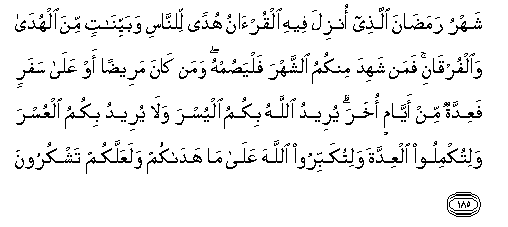
“Ramadan is the (month) in which was sent down the Qur’an, as a guide to mankind, also clear (signs) for guidance and a criterion (between right and wrong)…” AlBaqarah 2:185
The observation of Taqwa is also a method of acquiring this criterion. Allah subhanahu wa ta’aala says:
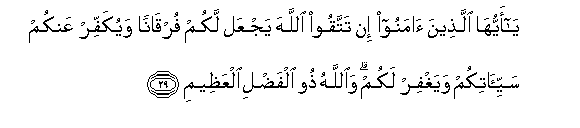
“O ye who believe! if ye fear Allah, He will grant you a Criterion (to judge between right and wrong)…” AlAnfaal 8:29.
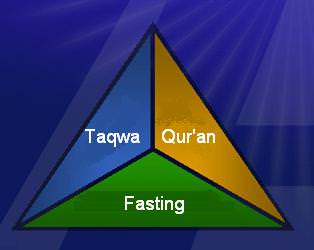
Fasting Ramadan, the observation of Taqwa (fearing Allah) in Ramadan, and the revelation of the Qur’an in Ramadan all together form a coherent relationship. They all happen to be in Ramadan. The three form a triangle of virtue; and hence the aspiration to obtain one cannot happen perfectly without the other two.
Ramadan cannot be successful without fasting, and fasting cannot be perfect without reciting the Qur’an. Taqwa is also hard to arrive at if we are to set the Qur’an or fasting aside. It’s a very powerful relationship.
To clarify this we shall discuss these relationships independently, starting with the main objective of fasting the month of Ramadan, Taqwa.
Part I: Fasting Ramadan and Taqwa
Ramadan comes every year and people know that. Ironically, regardless of how much they time they spend in preparation for it, they still come short and get the same feeling of nervousness as if they are fasting Ramadan for the first time in their life. And once Ramadan starts, they feel more relaxed.
Allah subahanahu wa ta’aala said:

“But remind (them), for indeed the reminder benefits the believer.” AlDhariyaat 51:55.
Some people are always alert and in full consciousness of their sense of servitude to Allah. Therefore, they regularly maintain the five daily prayers. Some need a weekly reminder and therefore feel their sense of servitude every Friday. Many unfortunately forget a lot, and an annual reminder is what is needed to bring them back to their sense of servitude to Allah. Other people however, take this reminder once in their life time. They only remember when they grow old enough to start thinking of going to Hajj as a declaration of Tawbah.
Ramadan is the blessed month, the annual reminder, the time for many people to reconcile with their Lord, and for people around to learn how to act as Muslims should. They always try their best to do well and hope to continue that way. It is a subtle inner struggle with our unsatisfactory self-worth in terms of the status of our Imaan and the level of our worship. Therefore, during the month of Ramadan the feeling of guilt arises, the spiritual drive gets higher, and the need for a commitment and a devotional lifestyle become demanding and more appealing than ever.
People in Ramadan get into the frenzy of Ibaadah in all of its aspects, physical, spiritual, financial, social…etc, in a manner that is not like any other season of the year. Ramadan creates a festivity of worship, where people enjoy giving, sacrificing, and devoting their time, day and night, for the sole purpose of Ibaadah.
This sudden change in attitude and course of conduct comes from inside-outside. Something affects the heart that sometimes makes even the most notorious people feel compelled to slow down on their evil and reflect as if they were touched by an angel.
Maybe there was no angelical touch at all, but for sure a spiritual touch changed their hearts. That is the compelling feeling of Taqwa, the sincere fearing of Allah and the desire to humble themselves to their Lord, which comes with this blessed month of fasting.
When the Messenger of Allah located the place of Taqwa he pointed to his heart and said: “Taqwa is over here” thrice, as in the hadith of Abu Hurayrah reported in Muslim.
He, salla Allahu alayhi wa sallam, further clarified in a Hadith from Al-Nu’man bin Basheer: “Indeed there is in the body a piece of flesh which if it is sound then the whole body is sound and if it is corrupt then the whole body is corrupt. Indeed it is the heart” (Al-Bukhari and Muslim).
From this we understand that the soundness of the heart means the soundness of Taqwa, the true experience of fearing Allah subhanahu wa ta’aala. And as a result of that a soundness of Amal or deeds should reflect on the actions and conduct of that individual.
When people start feeling humble during the month of Ramadan it is because the elements of Taqwa are creeping into their hearts secretly. That’s why Ramadan was named the month of Taqwa, and that’s why achieving Taqwa was made one of the main objectives of the fasting of Ramadan, “that ye may achieve Taqwa.” In another ayah within the context of fasting the month of Ramadan we read:

“Thus doth Allah make clear His Signs to men: that they may learn Taqwa (become righteous).” AlBaqarah 2:187.
What do we need Taqwa for?
We all need Taqwa to guarantee the acceptance of our deeds. Allah subhanahu wa ta’aala says:
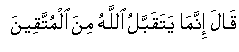
“Allah doth only accept from those who are righteous (Muttaqeen).” AlMa’edah 5:27
We need Taqwa because the good end in the Hereafter is again for the Muttaqeen, those who humble themselves in this world and those who are righteous.
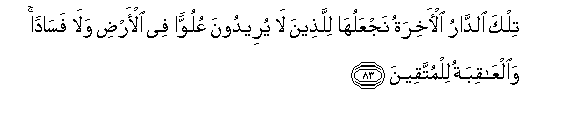
“That home of the Hereafter we shall give to those who intend not high- handedness or mischief on earth: and the end is (best) for the Righteous (Muttaqeen)” AlQasas 28:83.
We need Taqwa because we are all travelers, on our way to the Hereafter and we need the provision to help us reach our destination safely. The best provision a person can carry on this journey to the Hereafter is Taqwa.
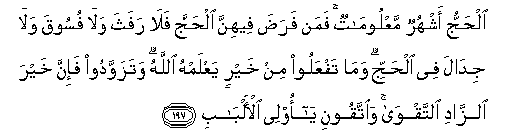
“…and take a provision (with you) for the journey, but the best of provisions is Taqwa (righteousness). So fear me, O ye that are wise.” AlBaqara 2:197
If you have Taqwa you will never feel lonely, because Allah is with you. Ibn Awn rahimahullah escorted a man on his way out on a long journey and told him: “Adhere to Taqwa (fearing) of Allah. For the Muttaqee (the righteous one) is never alone.”
And when Ali bin Abi Talib was asked to define Taqwa he said:
“Taqwa is to fear the Most Exalted One, work upon His revelation, become content and ascetic and always prepare for the departure from this life.”
Omar ibn Al-Khattab once asked Ubay ibn Ka’ab: How would you describe Taqwa? In reply Ubay asked, “Have you ever had to traverse a thorny path?” Omar replied in the affirmative and Ubay then continued, “How do you do so?” Omar said that he would carefully walk through after first having collected all loose and flowing clothing in his hands so nothing gets caught in the thorn. Ubay said: “This is the definition of Taqwa.”
Taqwa is all about being careful and being conscious of our actions, to make sure they are sound and right. Taqwa is about being conscious of Allah all the time, the area where people vary and are distinguished. Allah subahanahu wa ta’aala says:
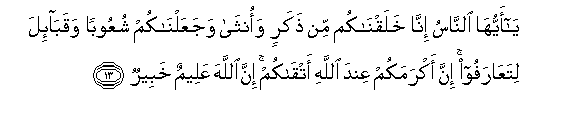
“…Verily the most honored of you in the sight of Allah is (he/she who is) the most righteous of you…” AlHujuraat 49:13.
Now, if Ramadan is all about Taqwa, and Taqwa is located in the heart, then indeed the true and most successful fasting would be the fasting of the heart, no more, no less.
Fasting means abstinence, and in the physical realm it’s the abstinence from eating, drinking, and sexual relations from dawn until sunset. The limit has been set for that. But the true abstinence is the one that has no limits, the abstinence of the heart from all that which might inflict and reflect wrong in our actions, statements and deeds.
Ibn Qayyim rahimahullah reflects on this saying that: “The example of the heart is the example of the king and the limbs are the recruited army. Hence they all go by the orders of their king. If the king was righteous he would order righteousness and if he was corrupt he would order corruption.” Aljawab AlKaafi.
Indeed, Taqwa is a degree of sincerity one cannot claim easily. It cannot simply be obtained by the mere presence of Ramadan; there is a lot on the part of every individual in order to get to that degree. Nevertheless, Ramadan at least provides and facilitates a tremendous opportunity to arrive at such level, if the rules of Ramadan were observed righteously.
Part 2 coming soon insha’Allah.
Keep supporting MuslimMatters for the sake of Allah
Alhamdulillah, we're at over 850 supporters. Help us get to 900 supporters this month. All it takes is a small gift from a reader like you to keep us going, for just $2 / month.
The Prophet (SAW) has taught us the best of deeds are those that done consistently, even if they are small. Click here to support MuslimMatters with a monthly donation of $2 per month. Set it and collect blessings from Allah (swt) for the khayr you're supporting without thinking about it.


[Podcast] Palestine in Our Hearts: Eid al-Fitr 1445 AH

Foreign Affairs Official Resigns Over Gaza Genocide

A Ramadan Quran Journal: A MuslimMatters Series – [Juz 30] Solace For The Sincere And Vulnerable

IOK Ramadan: The Importance of Spiritual Purification | Keys To The Divine Compass [Ep30]
IOK Ramadan: The Power of Prayer | Keys To The Divine Compass [Ep29]

IOK Ramadan: 7 Qualities of Highly Effective Believers | Keys To The Divine Compass [Ep18]
IOK Ramadan: Choose Wisely | Keys To The Divine Compass [Ep15]
IOK Ramadan: Shake the Trunk of the Tree | Keys To The Divine Compass [Ep16]
IOK Ramadan: Good and Bad are Tests from Allah | Keys To The Divine Compass [Ep17]
IOK Ramadan: Appreciating the Prophet ﷺ | Keys To The Divine Compass [Ep22]
IOK Ramadan: The Importance of Spiritual Purification | Keys To The Divine Compass [Ep30]
IOK Ramadan: The Power of Prayer | Keys To The Divine Compass [Ep29]
IOK Ramadan: The Weight of the Qur’an | Keys To The Divine Compass [Ep28]
IOK Ramadan: Families of Faith | Keys To The Divine Compass [Ep27]
IOK Ramadan: Humility in Front of the Messenger | Keys To The Divine Compass [Ep26]
-

 #Islam2 weeks ago
IOK Ramadan: 7 Qualities of Highly Effective Believers | Keys To The Divine Compass [Ep18]
-
#Islam2 weeks ago
IOK Ramadan: Choose Wisely | Keys To The Divine Compass [Ep15]
-
#Islam2 weeks ago
IOK Ramadan: Shake the Trunk of the Tree | Keys To The Divine Compass [Ep16]
-
#Islam2 weeks ago
IOK Ramadan: Good and Bad are Tests from Allah | Keys To The Divine Compass [Ep17]
MR
September 19, 2007 at 11:31 AM
Amazing point! I think I’ll use this for my khutbah. JazakAllah khair Sh. Yaser Birjas
Moiez
September 19, 2007 at 12:17 PM
I love you for the sake of Allah Shaikh!
Jazakallah Khair!
Amad
September 19, 2007 at 12:32 PM
jazakAllahkhair… I feel some taqwa building by just reading the article… :)
SH
September 19, 2007 at 12:57 PM
mashalla!!!! This article was simply amazing!! May allah reward you sheikh for facilitating our understaing of this blessed month..Ameen!!!!
aarij
September 19, 2007 at 1:01 PM
“Ramadan cannot be successful without fasting, and fasting cannot be perfect without reciting the Qur’an. Taqwa is also hard to arrive at if we are to set the Qur’an or fasting aside. It’s a very powerful relationship.”
wow, ma sha Allah. simply outstanding, sh. yaser. may Allah protect you, bless you and exponentially increase your rewards, ameen.
AnonyMouse
September 19, 2007 at 1:23 PM
JazakAllahu khairan, wa barakAllahu feek, Sheikh Yaser.
I remember you discussed this (albeit briefly) in the conference call, and I greatly appreciate you taking the time to go into greater detail…
May Allah make us all amongst those who have taqwa and experience a truly beneficial Ramadhaan, ameen!
...Niamah
September 19, 2007 at 2:19 PM
JazakAllah Khayr sheikh; May Allah swt help us all strength our relationship with Quran.
Niqaabis
September 19, 2007 at 4:10 PM
Jazaak Allaahu khairan for the eemaan lifting article
looking forward to part 2 inshaa Allaah.
Umm Layth
September 19, 2007 at 4:55 PM
Beautiful reminder Shaykh.
Jazaka Allahu Khair
inexplicabletimelessness
September 19, 2007 at 7:03 PM
Jazak Allahu khair Shaykh Yaser.
May Allah reward you, ameen.
Nasser Mahmoud
September 19, 2007 at 10:34 PM
Jazakum Allah ghair
Bint Bashir
September 20, 2007 at 12:21 AM
Salaams
Subhan’Allah what a beautiful reminder…
Hannah
September 20, 2007 at 6:26 AM
nicely laid out. mashaAllah.
AbdulHasib
September 20, 2007 at 9:07 AM
Brings back nice memories shaykhuna..
-)
We hope to see you again soon insha’aAllah for another eman raising series.
For anyone that’s interested. Shaykh Yaser hafidhahullah has an audio out as well regarding the topic..
http://hudarp.com/catalog/product_info.php?cPath=28_45&products_id=66
BaarakAllahufeek shaykhuna.
wa nasalAllahu ta’la anyaghfiralana wa iyyakum fi hadha-shahrul mubaarak. Ameen.
hijabhaven
September 20, 2007 at 9:14 AM
Subhan’Allah, there is always such beauty during Ramadhan. It’s true, as Ramadhan approaches I go through all sorts of emotions, and when it is finally here, it is as if there is an air of magic throughout the month.
We see many people doing so many good deeds and ibadah becomes so light and easy. It would be better if we were able to continue through the year.
Insha’Allah the annual reminder this year will stick until the next, especially when Muslims around the world are facing so much of hardship!
JazzakAllah for a brilliant yet moving post.
Anisah
September 20, 2007 at 11:15 PM
Masha’Allah, this is awesome!
Jazak’Allah
MR
September 21, 2007 at 7:00 AM
Sh. Yaser! I plagiarized your article for my khutbah. I’m sorry! Forgive me! :-D
...Niamah
September 21, 2007 at 10:50 AM
MR, find somebody more qualified then u to do Khutbah-
MR
September 21, 2007 at 11:07 AM
It’s our MSA khutbah, not a masjid. I’ve dont plent of khutbahs at my MSA. it’s not so bad.
MR
September 21, 2007 at 12:37 PM
PS – Technically I’m not actually giving the khutbah. I’m just giving the talk before the Arabic-only khutbah.
Make dua for me.
Abdur-Rehman
September 21, 2007 at 3:09 PM
Assalamu ‘alaikum,
always inspiring shaikh yaser, though i do prefer your audio for sure…
MR totally copied and pasted this article for the khutbah today, shaikh yaser birjas, please forgive him…
you should do copyright, shaikh yaser, i love you for the sake of Allah (S.W.A) and hope to learn from your manners and wisdoms when you come back to ny qabeelat tayybah…
insha-Allah…
Wassalam,
your student always,
Abdur-Rehman
Amad
September 21, 2007 at 10:30 PM
salam… i am assuming that you all are teasing MR… because really we all use the material of scholars and students of knowledge for our “laymen khutub”. And due to the dearth of khateebs available, all of us laymen are forced into this position one time or the other OR sometimes it is better for it if the alternative is worse!
So, MR, no problem… you or anyone else can use any material on this site at any time for khutbas!
Yaser Birjas
September 22, 2007 at 1:56 PM
One of our pious predecessors, I believe was Imam Ash-shabi, who was a great scholar of Hadith was praised for his knowledge tremendously. On hearing that praise he commented: “And what are we other than carriers?” i.e. we just carry the knowledge of those who came before us and convey the message.
Now that’s what we all share in common; ‘carrying the knowledge’ and then conveying it to others.
abu abdurrahman
September 23, 2007 at 2:00 AM
Subhanallah,
Wow, its a whole different thing when the Shuyukh write posts. No comparison.
Pingback: muslimmatters.org » Ramadan Checkup: Worshipping in the Last 10 Nights with Knowledge
sister
October 6, 2007 at 10:51 AM
One of our pious predecessors, I believe was Imam Ash-shabi, who was a great scholar of Hadith was praised for his knowledge tremendously. On hearing that praise he commented: “And what are we other than carriers?” i.e. we just carry the knowledge of those who came before us and convey the message.
Now that’s what we all share in common; ‘carrying the knowledge’ and then conveying it to others.
subhanallah beautifully explained!
Pingback: muslimmatters.org » Triangle of Virtue - Part 2